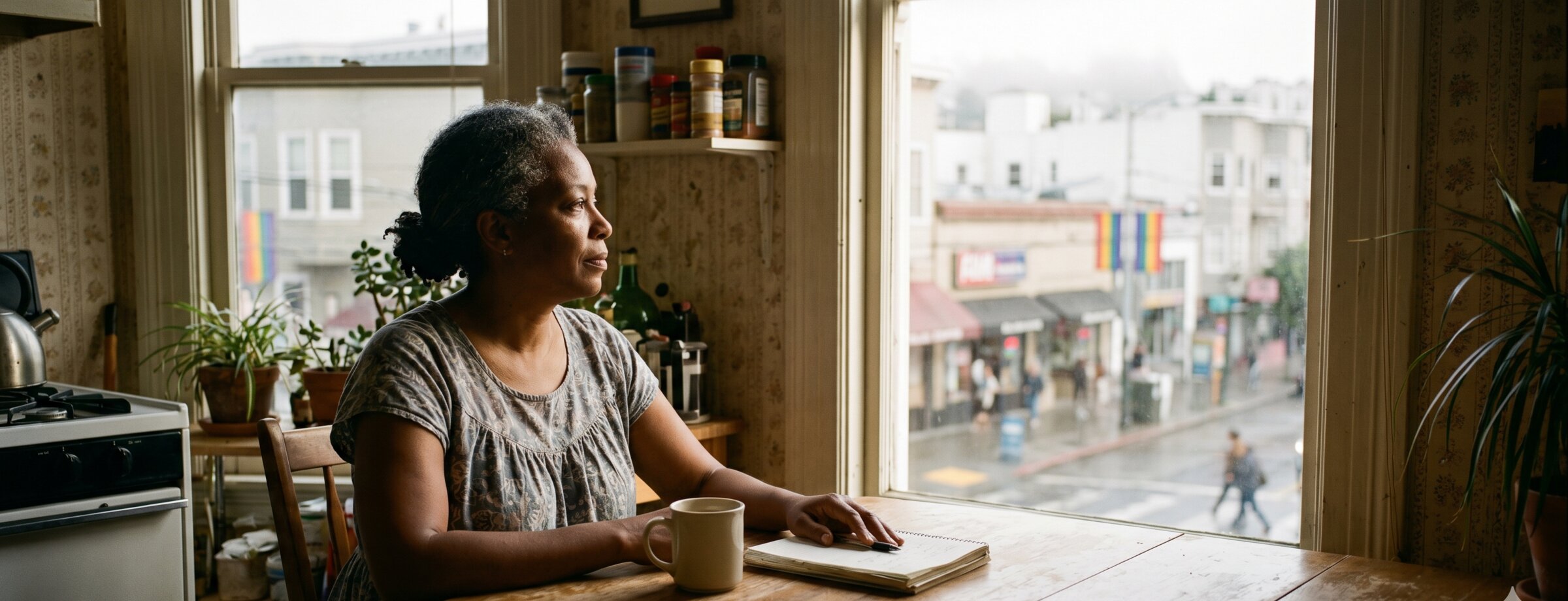
Behind a yellow duplex on Hartford Street in the Castro, in a sliver of garden the size of a one-car garage, Patrick Halloran has tended a memorial garden for AIDS victims since 1997. He started the year he turned 45. The garden contains 412 names. Each name is planted under a specific flower.
Patrick is 73. He lost his partner Daniel in 1991. He lost his best friend Tomás in 1994. He lost his brother Michael in 1996. He lost his upstairs neighbor Carlos in 1996. He bought the duplex in 1997 with the money from his mother’s estate and started the garden in the strip of dirt where the previous owner had kept a vegetable patch.
The garden is small. About 380 square feet, by city assessor records. The fence is wooden, painted gray. The gate has a brass key Patrick has had since the duplex closed. There is no plaque. There is no sign. There is one small wooden marker, hand-carved by a friend of Daniel’s in 1998, that says only: HERE.
The 412 names are not memorialized on plaques. They are memorialized in a leather-bound book Patrick keeps inside the duplex. Each entry has the name, the dates, and the flower under which the person is, in Patrick’s phrase, “planted.” Daniel is the white iris in the southeast corner. Tomás is the climbing yellow rose along the eastern fence. Michael is the small patch of borage in the front. Carlos is the lavender he replaces every three years because lavender, unfairly, only lives that long.
About a third of the 412 names are men Patrick knew personally. The other two-thirds are men whose families asked, over the years, if Patrick could plant a flower for their son. Patrick has never said no. He does not charge.
He works every Saturday morning from 6:30 until about 10. In the spring he is in the beds by 6 a.m. because the morning light is what makes the flowers actually open. He has not missed a Saturday in five years. The last Saturday he missed was the morning his sister called from Pennsylvania to say their mother had had a stroke. He flew out that afternoon. He came back ten days later. The garden waited.
“Every flower is a person,” he says. “Every weed I pull is something the person would not have let grow.”
The duplex itself is rent-stabilized. Patrick rents the upper unit to a younger couple, both of whom know about the garden and both of whom water in his absence. The arrangement has held for fourteen years.
The garden is not on any AIDS memorial tour. It is not on the city’s registry. About thirty people know it exists. Patrick has wondered, on occasion, if he should make it public. He has decided, every time, not to. The garden is for the dead, he says, not for the living to attend a docent tour.
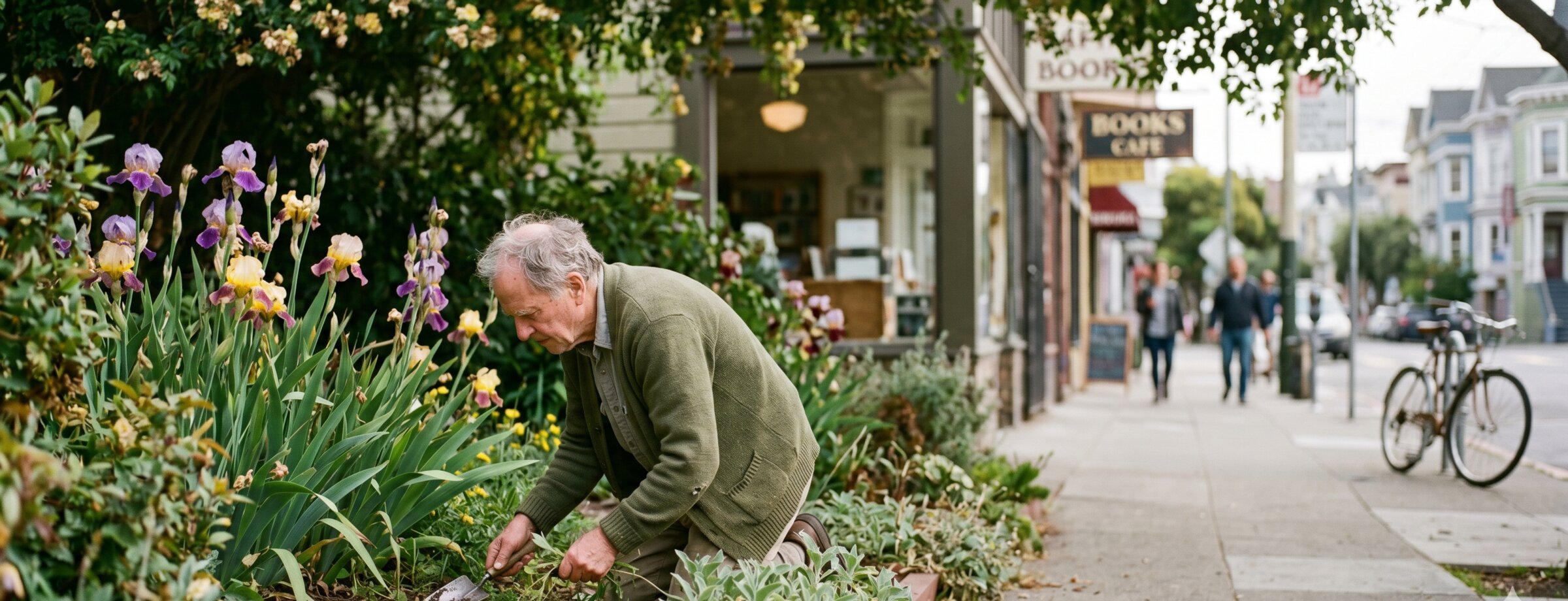
On the Saturday I visited at 8:21 a.m., Patrick was on his hands and knees in the iris bed. He was pulling a small clump of crabgrass that had appeared since the previous Saturday. He had a small wicker basket beside him for the weeds. The morning fog was lifting. The first sun came over the rooftop next door at 8:34. The white iris turned slightly to face it. Patrick stopped pulling for a moment to watch. Then he went back to the weeds.