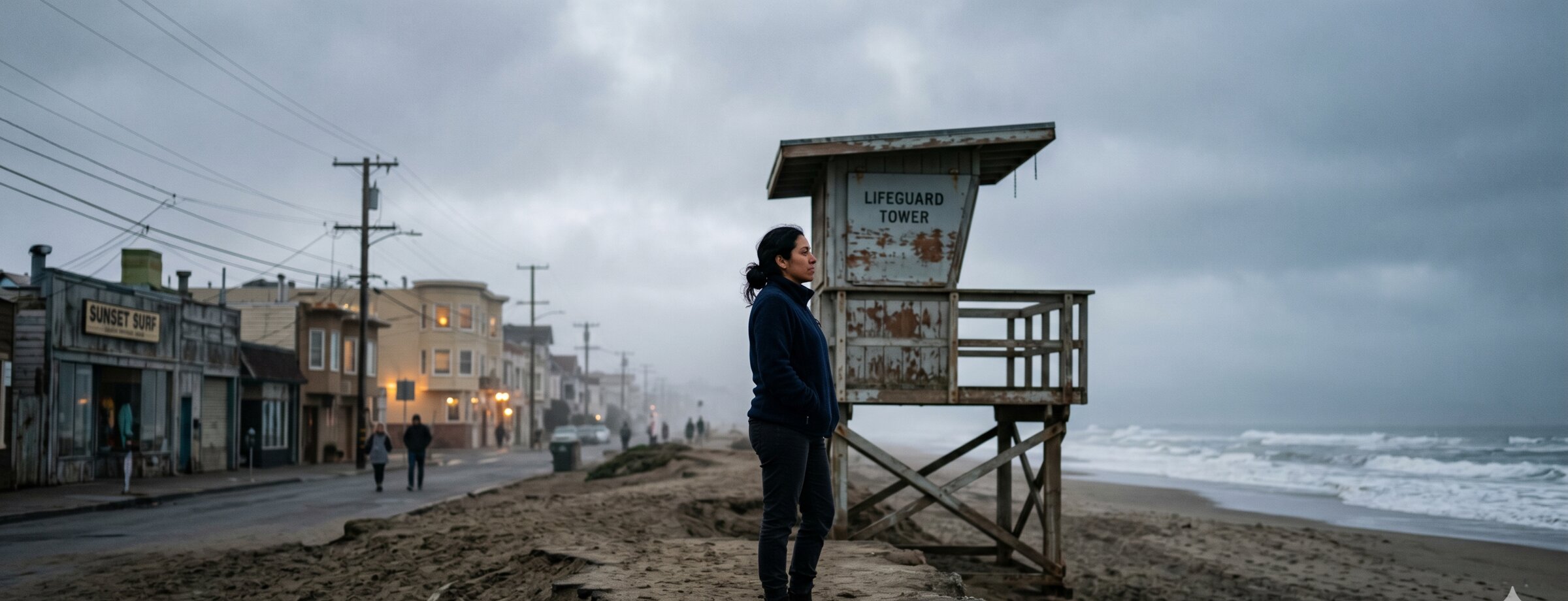
Ocean Beach runs about three and a half miles along the western edge of San Francisco, from Cliff House at the north end to Fort Funston at the south. It is, by the count of the National Park Service Coastal Hazards Office, one of the four deadliest beaches in California, and probably the single deadliest in the Bay Area. Between 1990 and 2024, sixty-two people have drowned in its rip currents and shore breaks. Most of them were tourists. Most of them were swimming alone.
Marlena Ortiz, 44, has been a National Park Service lifeguard at Ocean Beach for nineteen years. She has personally pulled forty-one swimmers out of the water in distress. Thirty-nine of those are alive today. Two are not. She remembers the names of both.
“The ocean does not forgive the same things twice,” Marlena says, on a Sunday morning in March at the southern lifeguard tower at Sloat Boulevard, looking at a flat, gray, dangerous sea. “The trick is knowing which thing today is.”
Marlena grew up in Pacifica. Her father was a commercial fisherman who worked out of Half Moon Bay until a stroke ended his career in 2003. She learned to surf at age ten. She learned to read the water at the same age, watching her father read it from the deck of a boat. She joined the NPS lifeguard program at twenty-five with a bachelor’s in marine biology from Humboldt.
The rip current at Ocean Beach is not constant. It is generated when waves break at angles that push water along the shore and then push that water back out to sea through narrow channels. The channels move. Marlena reads them by watching the foam, where the foam is moving back out instead of forward in, that is a rip. She also reads them by what the surf is wearing: the color of the water in the channel is slightly darker, slightly more uniform, because the channel is deeper and the sand has been swept out. The reading takes her, by her own estimate, about three seconds per scan. She makes a scan every twelve seconds when she is on the tower. That is three hundred scans an hour.
A swimmer in distress at Ocean Beach has, depending on water temperature and the swimmer’s fitness, between three and seven minutes before the cold and the panic overwhelm them. A lifeguard from the southern tower can reach a swimmer in the typical danger zone in about ninety seconds, sixty seconds to get to the water, thirty seconds in the water with the rescue board, assuming the swimmer is between one and two hundred yards out.
Marlena has, in nineteen years, made the swim 187 times. About half of those swims turned out to be unnecessary; the swimmer self-extricated or was not actually in trouble. The other half, about ninety swims, were saves. Of those ninety, forty-one were saves Marlena counts personally because the swimmer was clearly going to drown without her intervention. The other forty-nine were assists or precautionary pickups.
The two she did not save.
The first was Daniel Park, a twenty-three-year-old college student from Stanford who waded out at the south end on a hot Sunday in September 2013 with his sister, Esther, age nineteen. The siblings were caught in a rip that ran perpendicular to the beach about a hundred and thirty yards south of where Marlena was that day. She saw them go in. She had Esther on the rescue board within four minutes. Daniel had gone under by the time she got back to him. The Coast Guard found his body forty minutes later. He had been pulled south by the channel and was found near a kelp bed two hundred and fifty yards out.
The second was a woman named Imelda Rios, age forty-one, who waded out alone in May 2018 at a section of the beach where there were no other swimmers. Marlena saw her enter the water. Marlena hailed her on the megaphone three times to come back. Imelda did not come back. By the time Marlena got into the water, about ninety seconds after the third hail, Imelda was already face down. Marlena got her to the beach, started CPR, continued for twenty-one minutes until EMS pronounced her at 11:42 a.m. The coroner later found a high blood-alcohol level and a note in Imelda’s car. The note was addressed to Imelda’s mother.
Marlena keeps two photographs on the inside of her tower locker. One is of Daniel Park, taken by Esther from a Stanford newspaper article the year after. One is of Imelda Rios, taken from a memorial Facebook page that has not been updated since 2019. They are the same size, same matte cardstock, taped above her clipboard. She looks at them on every shift. She does not, she says, want to forget what she has not been able to do.
“You cannot save them all,” she says, and then she stops, and then she continues, more slowly: “You also do not get to say that out loud, ever, to a family on the beach who has just lost somebody. You can think it. You cannot say it. You stand there with the family and you do not say it, because they have already lost the person; the last thing they need is to lose the dignity of believing the person could have been saved. You say: I am very sorry. You say: he was strong. You say: she fought. You say what is true and what they can stand to hear at the same time, and you say nothing else.”
Marlena has trained, over nineteen years, fourteen junior lifeguards at the Ocean Beach tower system. Three of them are now full lifeguards in the National Park Service. One of them, a woman named Yvette Park, is the lifeguard at the central tower at Lawton Street. Yvette is, coincidentally, not related to Daniel Park; the families are from different parts of Korea. When Yvette was hired, in 2018, Marlena took her to the spot on the beach where Daniel had gone under. She did not tell Yvette the story. She just walked her to the spot. They stood there for two minutes. Marlena said: “This is where I lost one.” Yvette nodded. They walked back to the tower.
Marlena is not married. She has no children. She lives in a one-bedroom in the Outer Sunset, four blocks from the beach. She walks to work most mornings. She has, by her own count, walked between her apartment and the south tower 3,800 times.
On the Sunday I sat with her at the tower, the surf was breaking at five to seven feet with a heavy westerly swell. The water was 53°F. Two surfers were out at Sloat. Marlena watched them for forty minutes without looking away. She knew both of them by name. She had pulled one of them, Roberto, out of the same break in 2016. He had thanked her at the time. He came back to surf the next weekend. She had not stopped him. She would not have stopped him. The water, she says, is who they are. The trick of her job is to know who is in the water with their eyes open and who is in the water with their eyes closed. Roberto, that morning, had his eyes open. She watched him anyway.
At 11 a.m. a family of four arrived at the southern fence with a cooler and beach chairs. The two children, ages roughly six and four, ran toward the water. Marlena was off the tower in three seconds. She caught the older child by the shoulder of his sweatshirt before his bare feet reached the wet sand. She knelt down. She told him, in a voice that was neither angry nor afraid, that the water today was a tiger and that even a strong child like him could not swim in a tiger. The child looked at her. The child looked at the ocean. The child took two steps backward toward his mother. Marlena stood up. She walked back to the tower. She climbed the ladder. She picked up the binoculars. She started her scan over.
The waves kept coming.