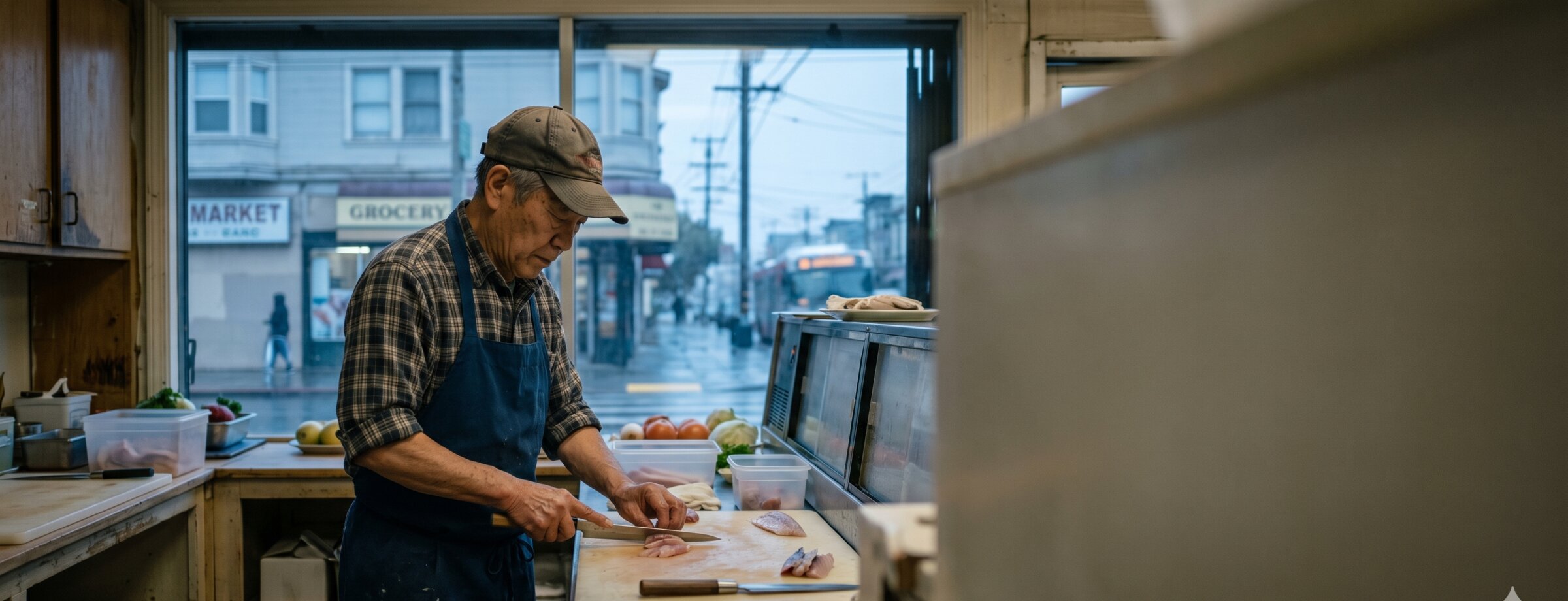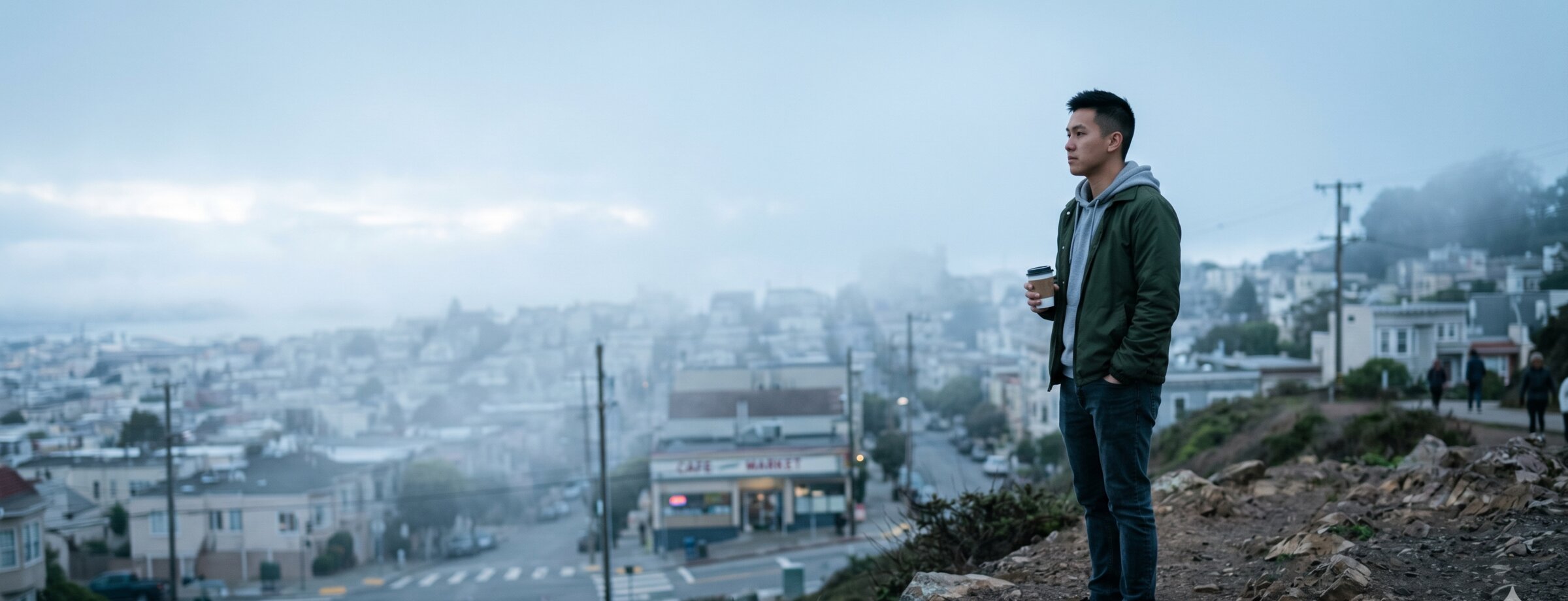
David Hsu retired from the National Weather Service in 2018 after 34 years as a marine forecaster for the Bay Area office. The Monday after he retired, he hiked Twin Peaks at sunrise and wrote a 200-word fog forecast for the day. He emailed it to four friends. The next day he did it again. Seven years later, he has not stopped.
David is 71. He hikes Twin Peaks every weekday at sunrise. He carries a small digital thermometer, a wind anemometer he bought used in 1997, and a paper notebook. He observes the fog for about twenty minutes from the south peak. He hikes back down by 7:30 a.m. He is at his kitchen table by 7:50 a.m. He has the forecast emailed by 8:15 a.m.
The mailing list has grown by word of mouth from 4 subscribers in 2018 to 1,400 today. The list is free. David has refused to monetize it. He has, by his own count, refused four sponsorship offers, three media-platform acquisition inquiries, and one offer from a Bay Area newspaper to syndicate the forecast for $400 a month.
The forecast is short. Always under 250 words. Always in plain English. It opens with a one-sentence headline (“The fog will burn off by 11 today, except west of 19th Avenue, where it will stay”) and proceeds through a four-paragraph technical breakdown: the marine layer temperature gradient, the wind from Point Reyes to the Golden Gate, the pressure differential between the bay and the Central Valley, the expected dissipation time by neighborhood.
“The fog is a creature,” David says. “It has moods. You learn to read them the way you learn a person.”
His subscribers include surfers at Ocean Beach, photographers, school bus dispatchers, a chef who plans her Saturday brunch fog/no-fog menu by it, two outdoor wedding planners, three commercial fisherman, a man who walks his dog from the Sunset to the Marina and adjusts the route by the forecast, a retired city librarian who reads it because she likes the writing, and David’s 96-year-old mother who lives in Daly City and tells him by phone every afternoon which part of his forecast was wrong that day.
He has not missed a weekday in seven years. He has hiked Twin Peaks in rain, in 40-mph wind, and twice in falling ash from wildfire smoke. He missed three Saturdays during a hip-surgery recovery in 2021. He does not send forecasts on weekends because, he says, weekends are for his grandchildren.
On the Tuesday I joined him at 6:42 a.m., the fog was sitting on the Outer Sunset like a coat. David watched it for nineteen minutes. He wrote three numbers in his notebook. He turned to me and said: “It will be gone by ten west of 22nd Avenue. East of 22nd, gone by nine. The Mission will see sun before the Marina. We will get one cloudless hour at lunch.”
By noon every word was right.