Miss Vivienne LaRue is the house mother of the Haus of LaRue, a drag family in the Castro that she founded in 1989. She has, in 36 years, raised forty-four drag daughters. Three of them died of AIDS-related complications between 1990 and 1996. The other forty-one are alive. The other forty-one call her every Sunday.
Miss Vivienne is 71. She was born in Mobile, Alabama, in 1955. She moved to San Francisco in 1978 at the age of 23 with a duffel bag, $140, and the name on her birth certificate she would later replace with the one she chose. She has lived in the Castro since 1981.
A drag mother, in the tradition that came up through the Black and Latino LGBTQ communities of New York and San Francisco in the 1970s and 1980s, is a person, usually but not always a senior drag performer, who teaches younger drag performers the craft, the politics, the names, the survival of the work. Mothers do not choose daughters. Daughters arrive. The mother decides whether to take them in.
“A mother does not choose her children, even a drag mother,” Miss Vivienne says. “The children walk into your apartment in tears and you let them stay. You feed them. You teach them their face. You teach them not to take what does not belong to them and to take everything that does.”
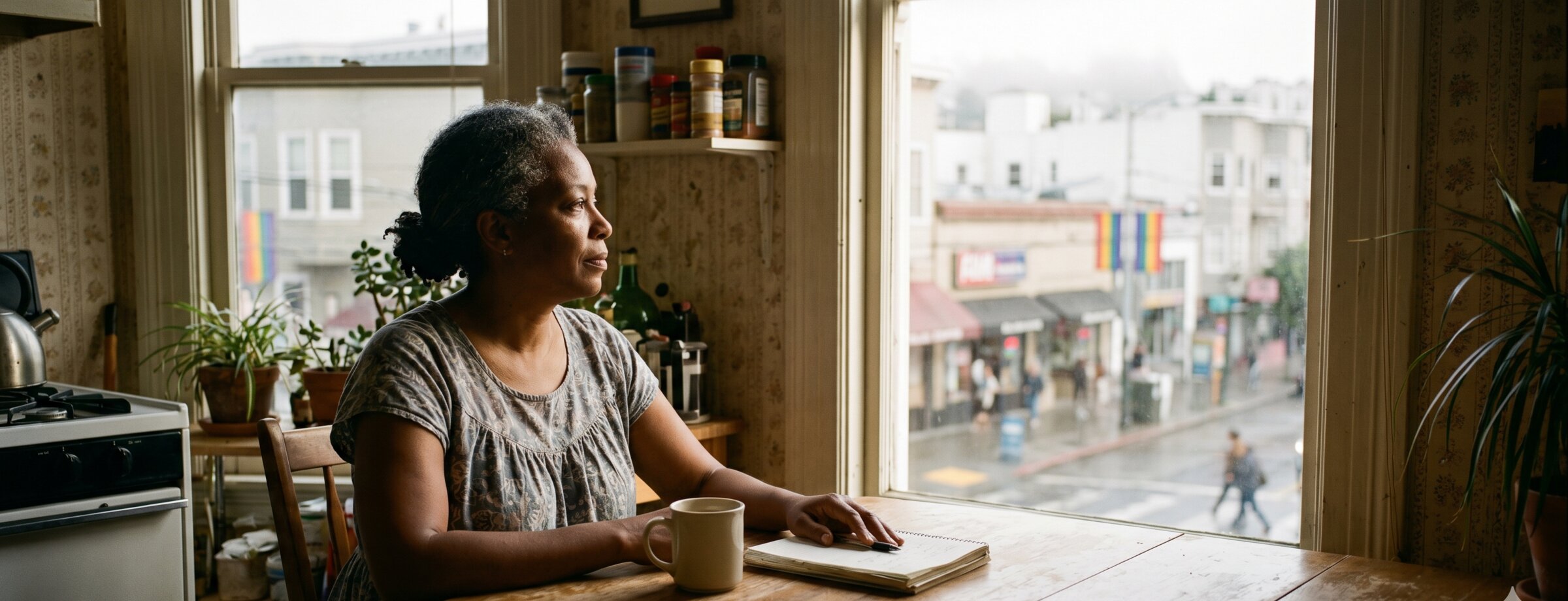
Miss Vivienne’s apartment is two blocks off Market. She has lived in it since 1984. The kitchen has been the meeting room of the Haus of LaRue since 1989. The kitchen table seats six comfortably; on Sunday afternoons, when most of her current six daughters come for dinner, the seventh chair is from the bedroom.
The names of the forty-four daughters are written in calligraphy on a piece of parchment Miss Vivienne keeps in a glass-fronted shadow box in her bedroom. Three names have a small gold star beside them, hand-painted, for the three who died. The daughters Miss Vivienne has raised include two pageant winners (a Miss Gay California in 2003 and a Miss Universe of Drag in 2017), one Broadway costume designer, one labor organizer for hotel workers, one immigration lawyer, and one nurse practitioner at Saint Francis Memorial whose Tuesday-Thursday shift takes care of the city’s unhoused.
In the 1990s, when the toll of AIDS was at its highest in the Castro, Miss Vivienne nursed all three of her daughters who died in their own apartments. She washed their bodies in their own bathrooms. She wrote the obituaries with their families when their families would speak to her. She walked at the front of each funeral procession in mourning drag.
The Haus of LaRue does pageant work, charitable work, and political work. In 2024 the haus collectively raised $42,000 for a local LGBTQ youth shelter. The fundraiser, held at a club on Polk, was hosted by Miss Vivienne and her current six daughters in matching emerald gowns. They have done the fundraiser every year since 2010.
On the Sunday I visited at 4:18 p.m., four of her current six daughters were at the table. One of the absent daughters was in Berlin on tour. The other was working a late shift. Miss Vivienne had cooked a pot roast and a pan of cornbread. She poured red wine into six glasses, set out water for the seventh place, and said grace in a voice that was, at age 71, still the voice of a performer.
I asked her what advice she gives every new daughter on their first day. She said: “I tell them, you have a mother now. The mother you came in with is a separate question. You also have a mother now.”