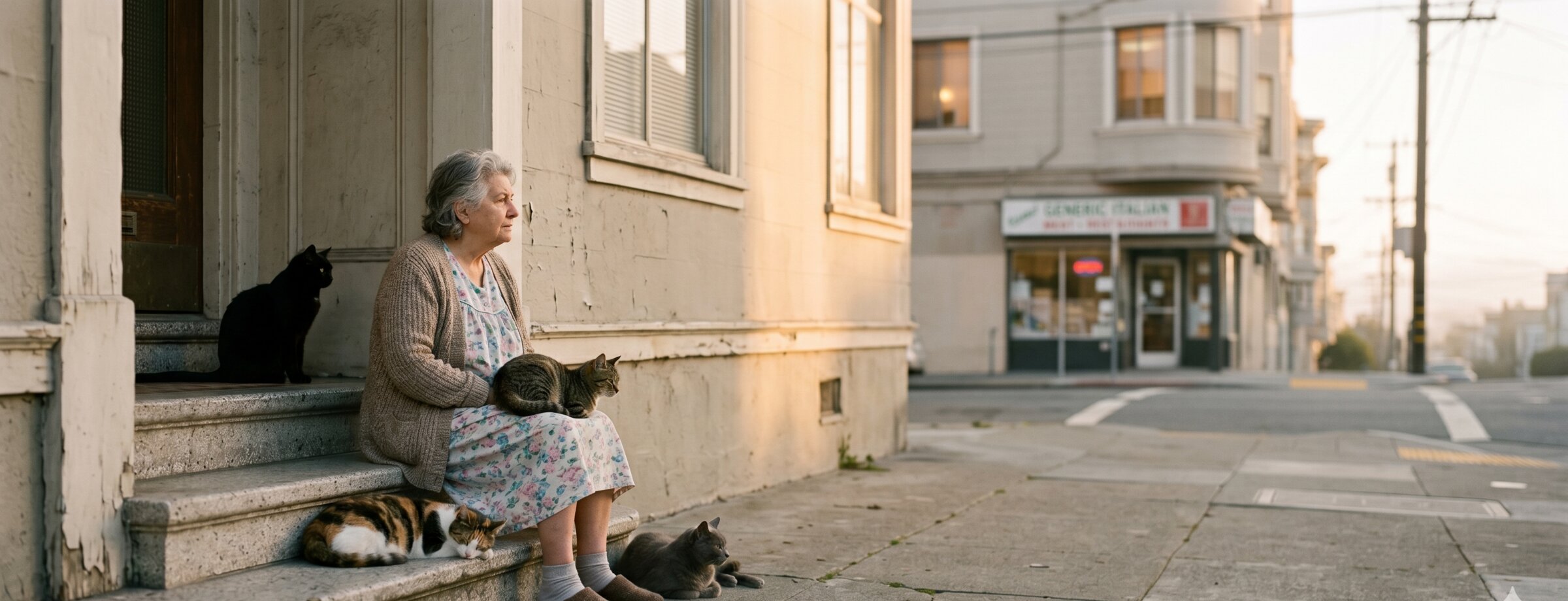
Mrs. Adriana Gianelli is 81. She lives in a four-room flat above a hardware store on Greenwich Street between Stockton and Powell. Her husband, Carlo, an opera lighting designer, died of AIDS-related pneumonia in October 1991. He was 49. Mrs. Gianelli has been feeding the cats on her block, by name, every morning at 5:45 a.m., since the morning after his funeral.
There are eleven cats now. There were thirty-eight at the peak in 1996. The number has climbed and fallen with the neighborhood’s tide of strays. Every cat she has fed has had a name. Every name is in a leather notebook on her kitchen table. The notebook is from a stationery shop in Florence she went to with Carlo on their honeymoon in 1969.
The first cat was Sergio. Sergio was Carlo’s cat. He was a black-and-white shorthair Carlo found in 1987 in the alley behind the SF Opera. Carlo carried him home in his coat. Sergio outlived Carlo by four years; he died in 1995 of kidney failure on the same kitchen tile where Mrs. Gianelli had fed him for eight years.
“My husband loved Sergio,” she says. “I did not, at first. I was a little jealous. By the end I loved them both the same. The thing I owed Sergio after Carlo died, I now owe every cat that walks down this block.”
Mrs. Gianelli buys cat food in 14-pound bags from a wholesale supplier in South San Francisco. She gets four bags a month delivered. The cost is $112. Her sister in Trieste sends her a check for $200 every quarter to help cover it. Mrs. Gianelli has refused the check three times and accepted it twelve times.
The cats know her doorway. She opens the door at 5:45. She sets out four small ceramic bowls on the second step. She fills each one half-full, never full, because the squirrels will come if there is excess. The cats eat in a rotation she has decoded but not formalized. The dominant cat, currently a tabby she calls Federico, eats first. The youngest, currently a black kitten she calls Olivia, eats last. The four bowls do not correspond to four cats; they correspond to four stations the cats have agreed on among themselves.
Mrs. Gianelli does not feed the cats inside. She has told her landlord, who is also her oldest friend, that she will move out before she turns the apartment into an animal facility. She wants the cats to be outdoor cats. She wants them to choose her. She thinks of indoor adoption as a kind of capture.
Three of the eleven current cats have been spayed or neutered through Pets Are Wonderful Support, a Bay Area program that subsidizes the surgery for low-income pet owners. Mrs. Gianelli is not technically the owner. The program does not ask. She has gotten 27 cats spayed or neutered over the years. The notebook records each one with a small star next to the name.
In 1991 the year of the deaths the worst hit street in San Francisco was Greenwich. Forty-one men in the four-block stretch between Powell and Mason died of AIDS-related illnesses between 1986 and 1992. Mrs. Gianelli wrote each one of their names in the back of the same notebook. She knew nineteen of them by sight, eight of them by first name, four of them well enough to make a meal for. She still puts a small flower on the bottom of the second step on the anniversary of each man’s death she remembers.
On the Sunday I visited, four cats came at the bowl, ate, washed, and dispersed. Mrs. Gianelli sat on the second step in a robe and watched. She said: “The cats know me. The men knew me. The block knows me. This is what I have. It is enough on most days.”
She closed the door at 6:11. She went upstairs. She made coffee. She wrote, in the notebook, the date and a single line: 11 October, Federico, Olivia, Marina, Beppe. Cool morning. Marina limping. She put a small star next to Marina’s name. She would call the spay-neuter program in the morning.