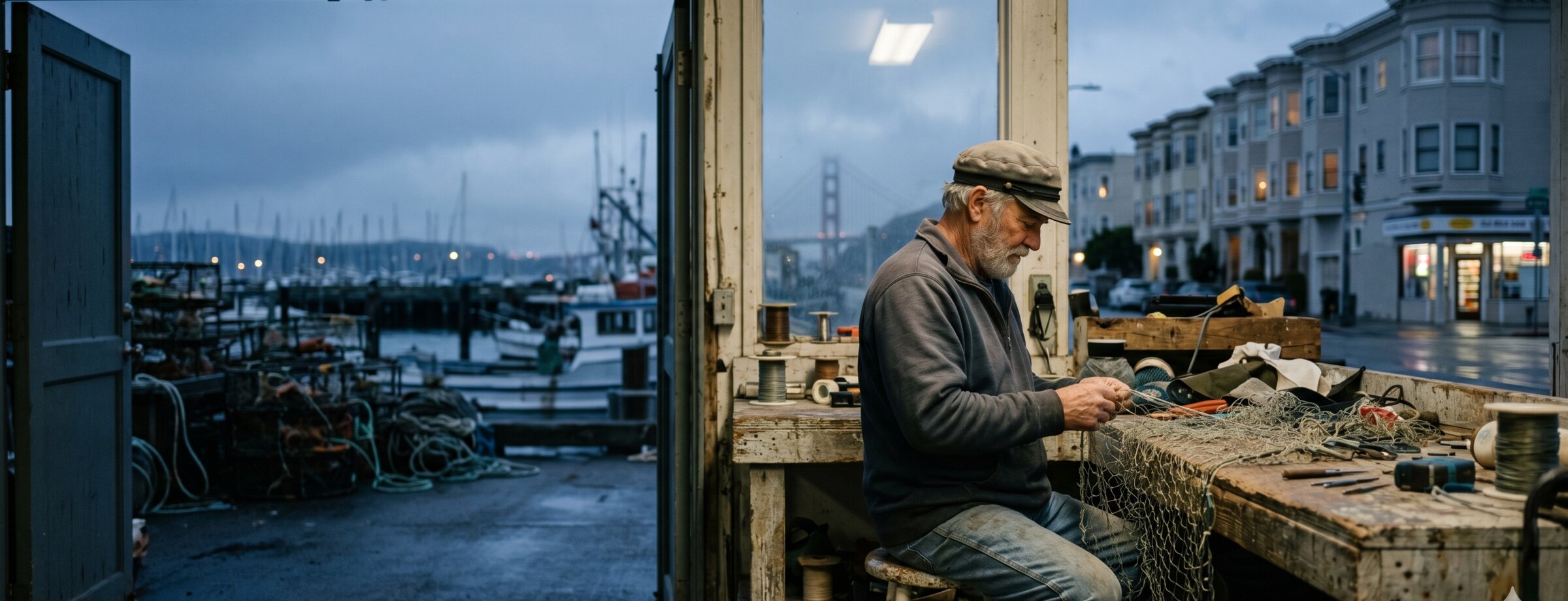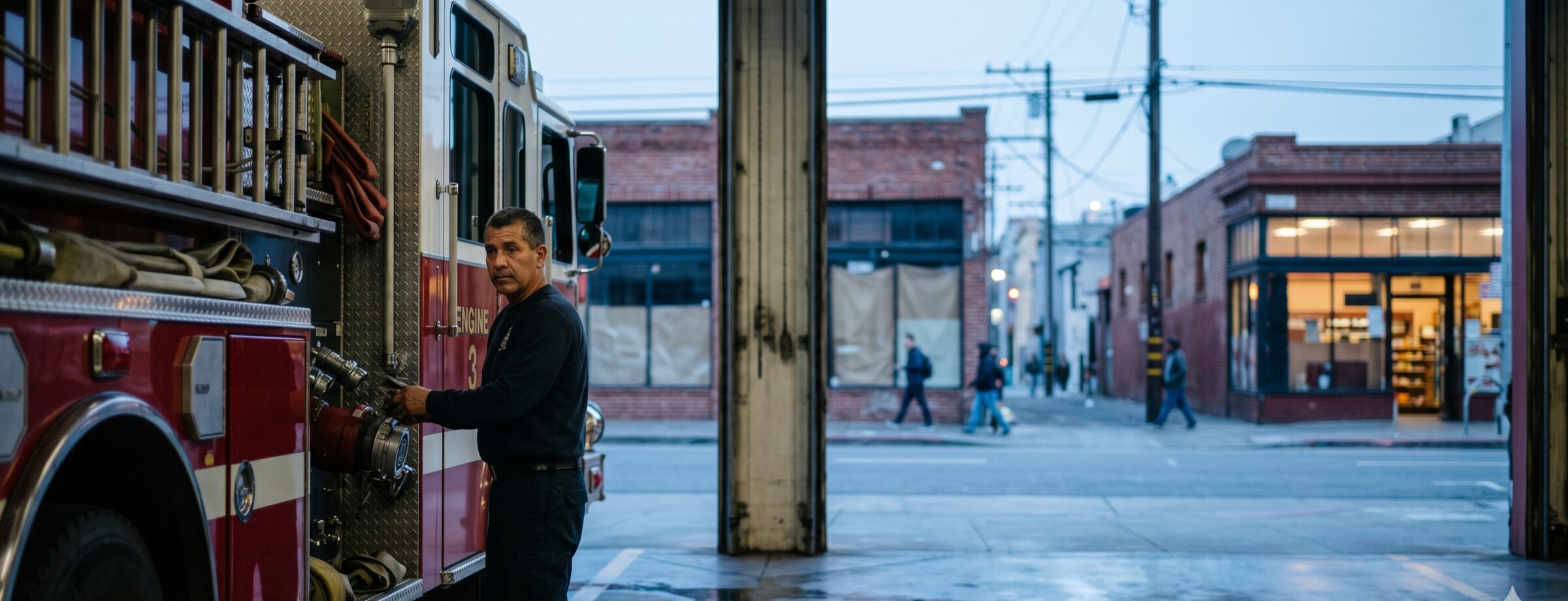
On Post Street in the Tenderloin, in Fire Station 3, there is a 2003 Pierce Quantum pumper truck designated Engine 3. The truck is red. It has 384,000 miles on the chassis. It has responded to, by the station’s log, 219,000 calls in its operational life. Sergio Banales, the lead mechanic for Engine 3, has personally turned a wrench on this truck or its three predecessor engines at Station 3 since the spring of 1989.
Sergio is 62. He was born in El Salvador in 1963. His family fled the civil war in 1981. He has been in the United States since age 18, in San Francisco since age 21, at the SFFD shop on 23rd Street since age 26. He has been the engineer-mechanic on Engine 3’s line of trucks for 36 years. He has watched four chiefs of the department come and go. He has buried two captains from Station 3. He has been at every retirement party of every Station 3 firefighter who has retired with their pension since 1991.
Sergio does not respond to fires. He is the mechanic. His job is to make sure that when the alarm goes off, Engine 3 starts. The alarm goes off, on average, at Station 3, twenty-two times a day. That is roughly 8,000 alarms a year. The engine starts every single time.
In the eleven years between 2014 and today, Engine 3 has not failed to start. Not once. Twice in those years it has failed mid-call, both times for cooling-system issues that Sergio caught on the post-mortem inspection and prevented from recurring. The 4-a.m. starts in cold January, the 2 a.m. starts after a 9-call evening when the engine block is hot, none have hesitated. This is, by any honest measure of mechanical reliability, a remarkable record. Sergio refuses to take credit for it. He says the engine wants to start because the engine knows what is at stake.
“The engine does not know it is a machine,” he says, in his low, slow voice with the Spanish-accented r’s. “The engine knows there are people who will die without it. I do not let it forget the second thing.”
On a typical Thursday, Sergio arrives at Station 3 at 5:30 a.m. He pulls the maintenance log. He walks around Engine 3 once, slowly. He gets underneath with a flashlight. He checks all twelve coolant hose clamps, eight by eight, on a rotating two-week cycle. He checks the pump primer. He checks the air brakes. He checks the foam tank level. He starts the engine cold, listens for ninety seconds, kills the engine, and writes one of three letters in the log: G (good), W (watch), R (replace).
He has written R fourteen times in thirty-six years. Three for the water pump. Two for the foam-tank pump motor. Two for cracked hoses. One for an alternator. One for a steering linkage that he could feel was wrong but that no test would have caught for another six months. He has replaced the engine block, in three different trucks, four times. Each replacement, he says, “is a death and a birth at the same time.”
Sergio has slept in the apparatus bay twice. The first was January 1994, the night of a particularly heavy storm. A tree had fallen on a Tenderloin SRO and Engine 3 had been out on the call for nineteen consecutive hours. Sergio drove to the station at 2 a.m. to inspect the engine when it returned and was so spent he slept on a cot in the bay until 6 a.m.
The second was December 19, 2003. That was the day Sergio’s wife, Margarita, died of an aneurysm at age 39, suddenly, in their kitchen. Sergio called his sister to be with their two daughters. He drove to Station 3 at 11 p.m. He opened the bay. He pulled out Engine 3 (which was, at that time, a 1996 Pierce). He sat down on the concrete next to the truck. He put his hand on the running board. He stayed there until the morning shift came on at 6 a.m. He has cried, in front of a member of his own family, exactly once in his life. He cried in front of Engine 3 on that night.
Sergio has been offered four promotions in his career. He has refused each one. The promotions would have taken him to the central shop, to administrative work, to a larger fleet. He has stayed with the same single truck and its line of successors at the same single station. The Captain of Station 3 in 2018 wrote a memo to the deputy chief recommending Sergio be promoted to assistant superintendent of the entire SFFD fleet. Sergio went to the deputy chief’s office, on his own, and asked for the memo to be withdrawn. He gave one sentence of explanation. He said: “Engine 3 is mine to keep alive.”
I asked Sergio if anyone could replace him when he retires. He said yes, of course. He has, in fact, been training his successor, a thirty-eight-year-old mechanic named Rosa Velasquez, for the past four years. Rosa has been Sergio’s shadow since 2021. She is, by his own assessment, “a better mechanic than I was at her age.” She will take over when Sergio retires at sixty-five. Sergio has, however, told Rosa one rule: she has to walk around Engine 3 once, in silence, every Thursday morning at 5:30. The walk-around does not have to be technical. It does not have to be even an inspection. It has to be a walk. Rosa, who is a Berkeley engineering graduate and a woman of normally efficient temperament, has agreed.
In December 2023 the Captain of Station 3, a man named Aaron Chen, told me on background that Engine 3 is the most reliable piece of equipment in the SFFD fleet of 51 active engines and trucks, by a measurable margin. Captain Chen said the difference is, in his estimation, “ninety-two percent Sergio.” The other eight percent, he said, “is that I think Engine 3 is in love with Sergio.”
On the Thursday I visited at 5:48 a.m., Sergio was checking the steering linkage. He had a small flashlight in his teeth. The first alarm of the morning went off at 6:14. Five firefighters were on the truck and out the bay door in 51 seconds. Sergio watched the engine pull away. He stood there in the apparatus bay until the sound of the siren had faded down Larkin Street. Then he turned, picked up his clipboard, and started his post-departure inspection of the bay floor for fluid leaks.