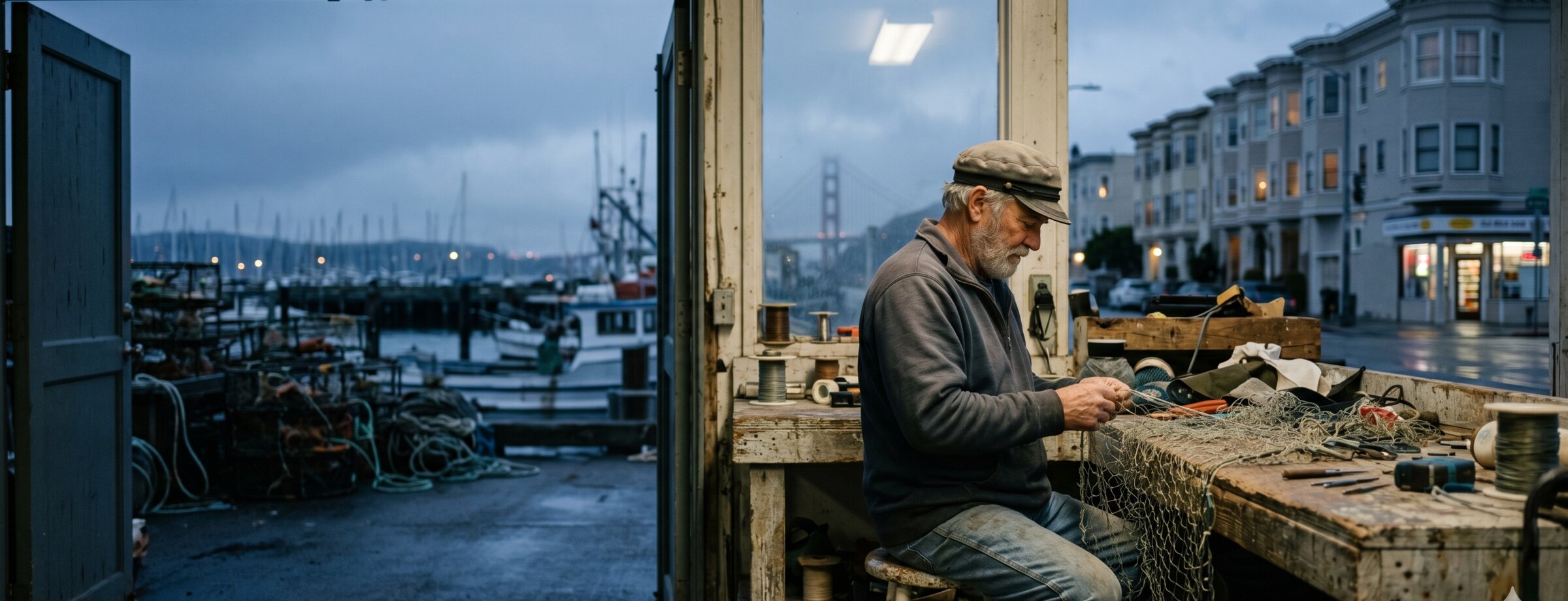
On Pier 45 at Fisherman’s Wharf, in a small wooden shed at the end of the dock, Captain Frank Costa has been splicing rope for the working fishing boats since 1984. The shed has his name hand-painted above the door. Inside is a 1957 marlinspike his father gave him at age 14, plus about six hundred pounds of various weights and types of marine rope, plus a small refrigerator with two bottles of Portuguese vinho verde he opens with crews who have had a good week at sea.
Captain Frank is 70. He came to San Francisco from the Azores in 1969, at age 14, with his father, who was a fisherman. He fished out of Fisherman’s Wharf for sixteen years before opening his splicing shed in 1984. He has 8 fingers. He lost the pinky and the index finger of his right hand in a winch accident on his uncle’s boat in 1991.
“You do not need ten fingers to splice,” he says. “You need two thumbs and a head that knows what the rope wants.”
A splice is the joining of two ends of rope by interweaving the strands, without a knot. Done correctly, a splice retains about 95% of the rope’s breaking strength; a knot retains only 60-70%. For working boats, every splice matters.
Captain Frank has spliced, by his own ledger, about 18,000 rope pieces in 41 years. He charges by the splice, not by the hour: $40 for a basic eye splice on standard rope, $90 for a long splice, $140 for a wire-to-rope splice. Most of his customers have known him for decades and pay in cash.
There are nine working fishing boats left at Fisherman’s Wharf. In 1984 there were 71. Frank knows every captain by first name and every boat by its splice patterns; he can identify which boat a piece of rope came from, he says, by the way it was last spliced, the same way a graphologist identifies handwriting.
The Wharf has changed under him. The tourists come now in numbers his father would not have recognized. The crab fishery has shifted twice. The big seafood restaurants that used to buy direct from the boats now mostly source from wholesalers. Frank says the splicing has not changed because, in his words, “rope does not know what year it is.”
In 2008 a film crew from a national reality show approached him about featuring his shed in a series. Frank refused. He said the shed was not a stage. The crew offered him $12,000. He said the shed still was not a stage. The crew left.
On the Wednesday I visited at 6:14 a.m., Frank was finishing an eye splice on a 1-inch nylon line for a salmon boat called the Nossa Senhora. He worked with the eight fingers he has. The splice took him fourteen minutes. The captain of the Nossa Senhora paid him in cash and a small bag of fresh-caught Chinook. Frank put the bag in the refrigerator next to the wine. He moved on to the next length of rope. The fog at the end of the pier was beginning to burn off.