
Six years in a Dogpatch studio. The waitlist is fifteen months long. She has turned down every wholesale offer that would change the math.
IN COLLABORATION WITH ROSE AKIYAMA CERAMICS
ISSUE №53 · MAY 2, 2026 · 4-MIN READ
ROSE AKIYAMA THROWS FORTY BOWLS A WEEK. SHE WILL NOT THROW FORTY-ONE.
BY DAISY · PHOTOGRAPHS BY KIWI
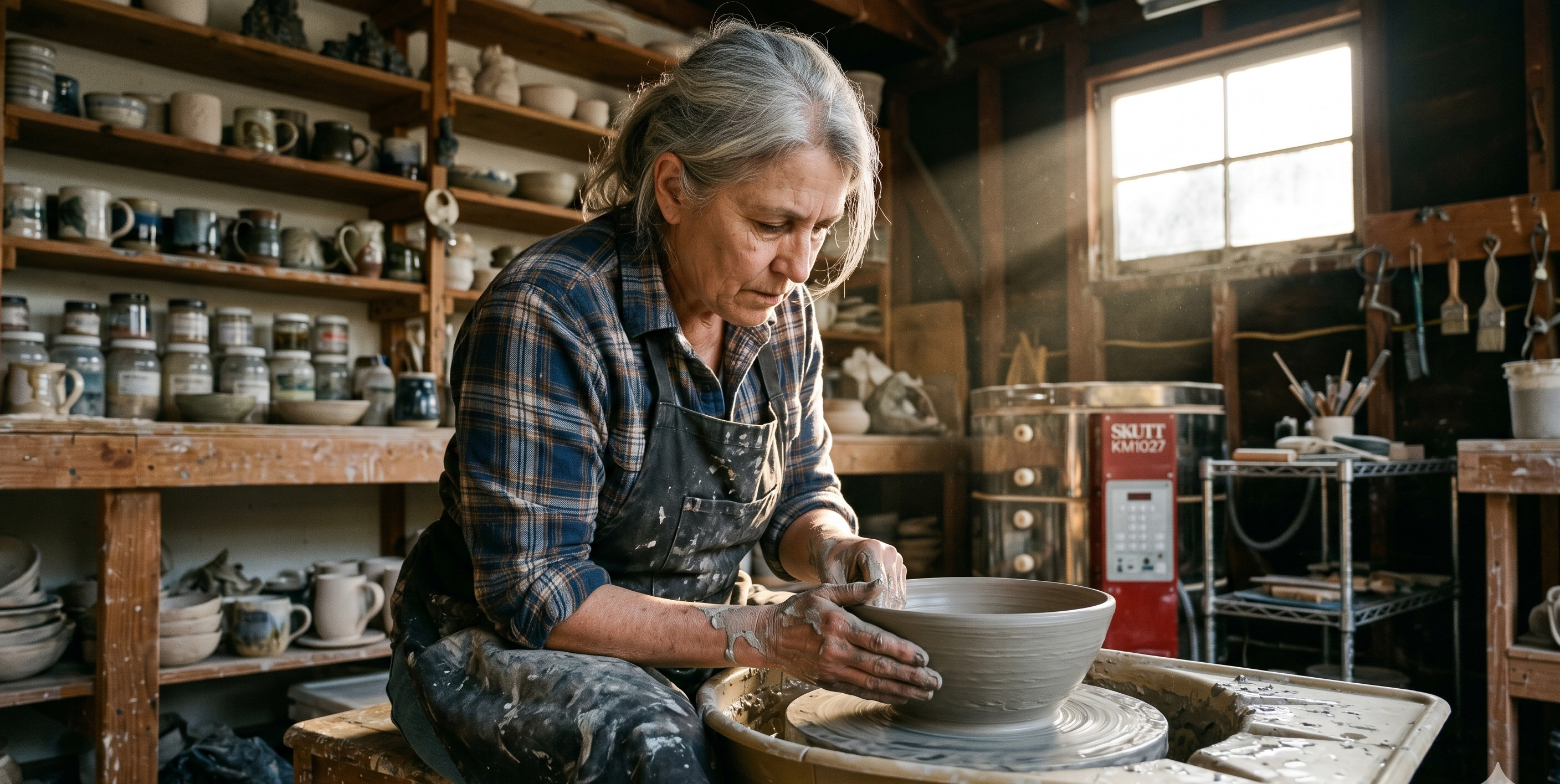
Rose Akiyama’s studio is on the second floor of a building on 22nd Street in the Dogpatch, between Tennessee and Minnesota. Six years. Three hundred eighty square feet. One wheel, one kiln, twenty-three shelves of cured pieces waiting for the second firing. She works alone, four days a week, ten hours a day. She throws forty bowls a week. She has thrown forty bowls a week for six years. The number does not change.
The waitlist is fifteen months long. She has not opened it to new names since 2024. The people on it are people who got on in 2024 or earlier. They will receive their pieces over the next year and a half. Then the waitlist will be empty for thirty days. Then she will open it again for thirty days. Then it will close again. This is the pattern she has settled into.
The math of forty is the conversation she has been having with collectors, gallerists, and wholesale buyers for four years. A San Francisco-based design store offered her a standing order of forty bowls a month, at a wholesale discount, for two years. She declined. A national hospitality group offered her a custom commission of two hundred bowls for a restaurant opening. She declined. A larger studio offered her a partnership where she would design and they would produce. She declined. Each refusal was kind. Each refusal was specific. She has a one-line explanation that she has given so many times she does not need to think about it.
“Forty is the number I can throw and still know each one before it goes in the kiln. Forty-one is the number where one of them becomes a stranger to me. I am not interested in making strangers.”
The bowls themselves are recognizably hers. White stoneware. Tight foot. A glaze she developed in 2021 over six months of testing, named for the color of the ceiling in her grandmother’s house in Tokyo in 1976. She does not name pieces. She does not number them. She makes a small mark on the foot of each one, a single chisel scratch in a position she varies by week. The position tells her, on a glance, which week the bowl was thrown. She can name the temperature of the kiln that day, the weather, what she was listening to.
Her training is from her grandmother. Three summers in Tokyo, from age eleven to thirteen, watching the work and then doing some of it. Her grandmother died in 2009. The grandmother’s wheel is in storage in Daly City. Rose has thought about bringing it to the studio. She has decided that her grandmother taught her to work, not to memorialize. The wheel stays in storage.
She prices a bowl at $185. This has been the price for three years. The collectors who buy from her treat the price as honest, because they have done the math themselves: ten hours of work, plus the kiln, plus the studio rent, plus the glaze, divided by forty. The math works at $185. It also works at $230, which is what a similar potter at a similar level charges in Brooklyn. Rose has had this conversation with three different gallerists. She is keeping the price at $185 because the math works and because the people who buy her bowls eat out of them. They are not collectors of art. They are people who want to eat oatmeal in the morning from a bowl that someone made carefully.
The studio is open to visitors on Wednesdays from 2 p.m. to 5 p.m. by appointment. She does not sell from the studio. The appointments are for collectors picking up pieces and for friends. She has not advertised the open hours. The fact that she has them is something her collectors share by word of mouth.
When I asked her if she would consider hiring a studio assistant, even one day a week, even to help with the wedging and the trimming, she said the same thing she has said to every interviewer for six years. Maybe. Not yet. The math is still working.
“Forty is the number I can throw and still know each one before it goes in the kiln. Forty-one is the number where one of them becomes a stranger to me. I am not interested in making strangers.”
ROSE AKIYAMA, POTTER
WORK WITH THE KEEPERS
Partner packages
Sponsor a saturday, a profile, a season, or a year. Real editorial firewall.
Tell us your story
Operator, keeper, regular, kid with a paper route. Pitch us what you know.
Send a tip
Anonymous if you want. We chase every one we can verify.
We're hiring
Student journalism roles. Paid. SF or Bay Area. See the open list.
READ NEXT
ISSUE №58 · BY ERIC

Zareen's Opens a Fourth Kitchen
ISSUE №57 · BY DAISY
Olive Branch Roasters and the Two-Lot Theory of Coffee
ISSUE №56 · BY NICHOLAS