It is 4:15 on a Tuesday afternoon in the front room of a wood-frame house on Cortland Avenue near Banks Street. A girl named Sienna, 9, is sitting on a piano bench that has been in this room for 51 years, working through the second movement of a Clementi sonatina. Her mother, who is in the kitchen with Frances Eldridge, played the same sonatina in this same room in 1997.
Frances is 79. She bought the house in 1974 with her late husband, Dean, who was a high school music teacher and died of complications from Parkinson’s in 2008. The piano, a 1962 Yamaha U3 upright, came with the house from a previous owner who could not get it down the stairs. Frances has had it tuned twice a year for 51 years by the same tuner, Donald Choi, who himself has been profiled in this paper.
She estimates she has taught about 380 students. Her current book has 22. Eight of them are children of former students. One, a boy named Theo, is the grandchild of a student. His grandmother, Helen, was nine when she started lessons in 1981. Helen is 54 now. She drives Theo from the Outer Sunset to Bernal twice a month.
“There is no good word in English for the thing you become when you teach a child for ten years and then their child for ten years,” Frances says. “Auntie is close. The Cantonese word for it is closer. The Korean word is closer still.”
Lessons are 45 minutes. She charges $80, paid monthly. She has not raised her rate since 2018. The kitchen always has a kettle on. Most students get a cup of tea when they arrive. Smaller students get hot chocolate. Theo, who is six, gets apple juice in the same yellow Fisher-Price cup that his mother used at his age.
Frances does not teach to a curriculum. She teaches to a child. Sienna is on Clementi this month because Frances heard her hum a Clementi melody in March, in passing, while she was waiting for her mother to finish chatting at the door. Theo is on simplified Bach because Bach is what his grandmother started on, and Frances thinks Theo holds his hands the same way.
The room has not changed in any major way since 1989. The piano, the bench, two chairs, a window onto Cortland, a bookshelf of method books, a small framed photograph of Dean conducting a high school orchestra in 1986. There is a sticker on the inside of the piano lid that reads, in a child’s handwriting, “FOR FRANCES, FROM CECILIA, 1992.” Cecilia is now a professional cellist in Boston. She mailed Frances a copy of her first album in 2014.
In 1995 Frances was diagnosed with breast cancer. She had a mastectomy and six months of chemotherapy. She missed five weeks of lessons. Her oldest student at the time, a girl named Maya, was 14 and had been with her since age 7. Maya came to her house every Saturday during those five weeks and played for her without a lesson. Maya is now a music professor at UC Davis. She has not been Frances’s student for thirty years. She still calls on Frances’s birthday.
I asked Frances how she has known when a child is done. She said: when the child stops looking at the keys and starts looking past them, at the air over the keys, at a room that is not the front room on Cortland. That is when they are done. That is when she calls the parents and tells them, gently, that her job is finished.
She has done this 47 times in 51 years. She remembers all 47 final lessons. She remembers the piece. She remembers what the parent said when they came to the door.
Sienna is not done. Sienna is six years away from being done, by Frances’s estimate, possibly more. She finishes the second movement of the Clementi. There is a small mistake in measure 14. Frances, sitting beside her on the bench, does not say anything. She points, just once, with her index finger, at the place. Sienna nods. She plays it again. This time it is right. She does not look at the keys when she plays it.
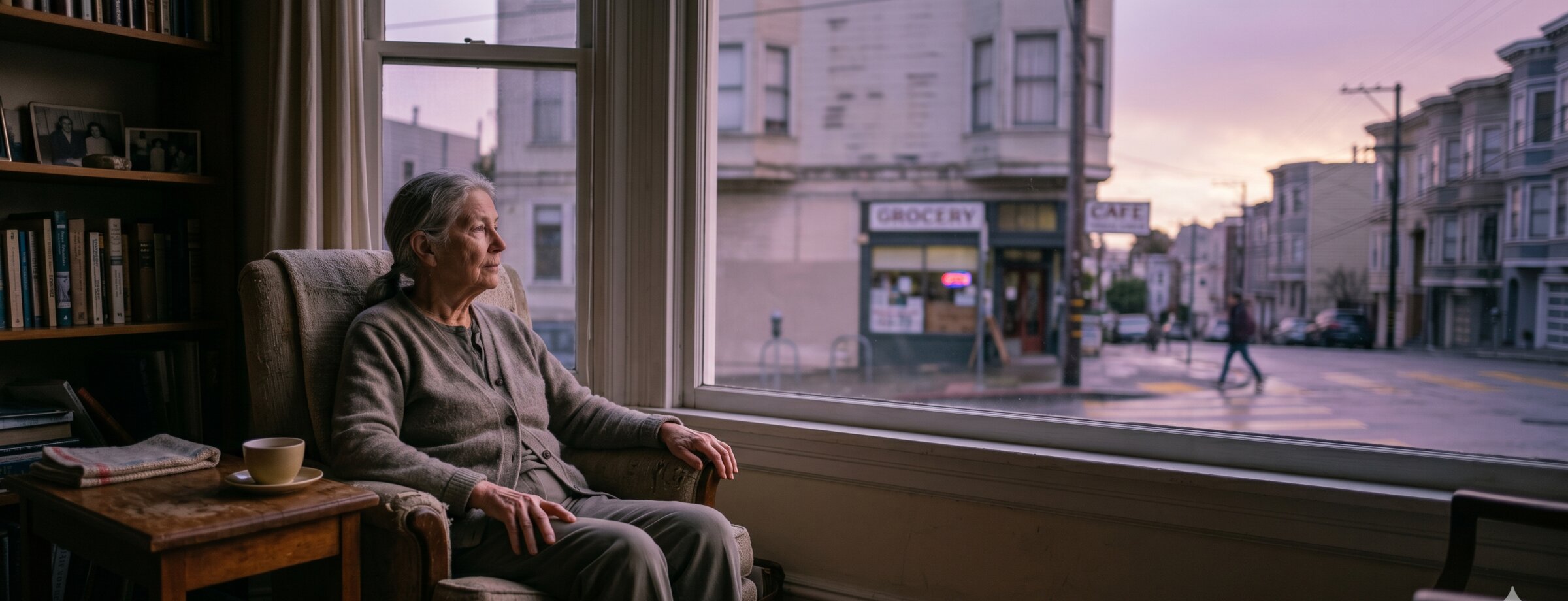
At 5:00, Sienna and her mother leave. Frances pours herself a cup of tea. She sits on the piano bench for a moment with the lid closed. She has done this between lessons for 51 years. Donald Choi will come tomorrow morning at 10. The piano needs a small adjustment on the C above middle C. She wrote it on a Post-it on the lid in pencil last week.