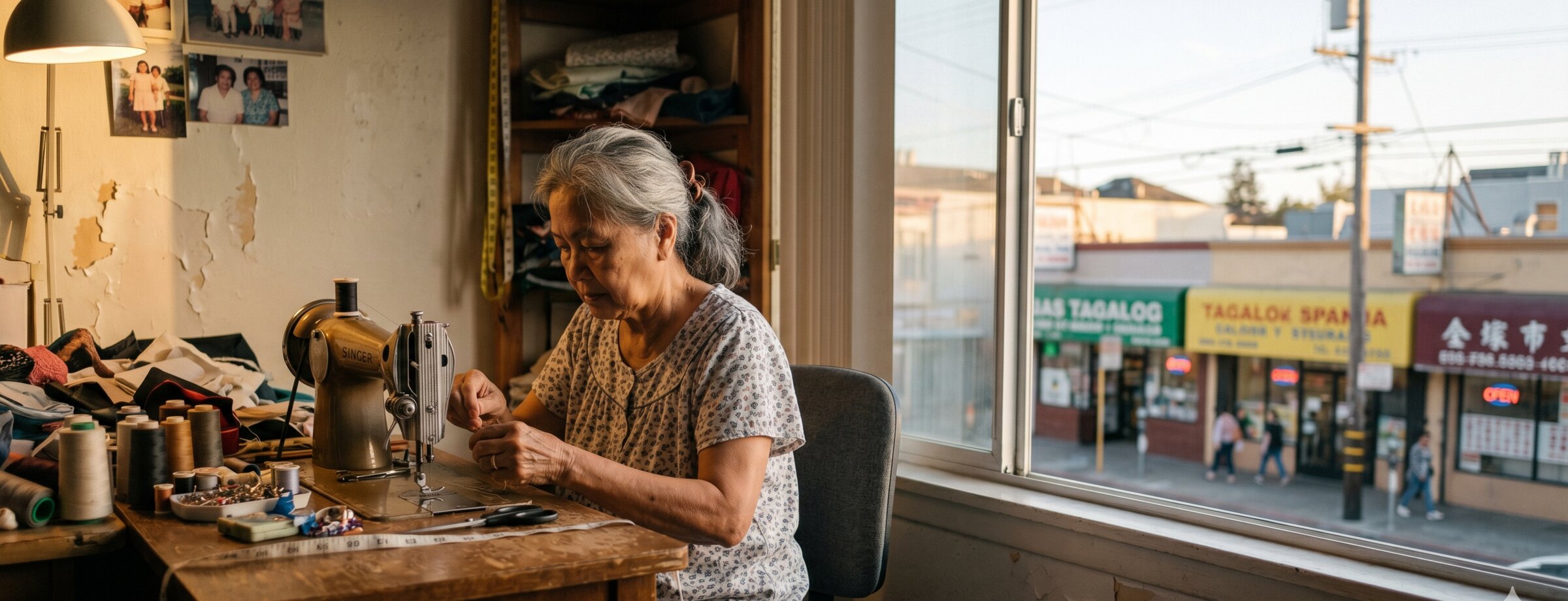
In a one-bedroom apartment on Geneva Avenue, on the third floor of a six-unit walk-up, Tita Aurora Reyes has hand-sewn barong tagalogs, the traditional embroidered Filipino men’s formal shirt, since 1984. By her own count she has finished about 6,000 of them. Most have been worn at weddings, baptisms, and graduations within the Filipino American community of San Francisco.
Aurora is 73. She came to San Francisco from Cebu in 1977. She worked at three different alteration shops in the Mission and Daly City before going independent in 1984.
A real barong is made from piña (pineapple) fiber or jusi (banana silk). The embroidery, calado work, white-on-white, hand-stitched, is what makes a barong a barong. Aurora does the calado herself, by hand, with a needle and thread the thickness of a human hair. A standard wedding barong takes her between 60 and 90 hours of embroidery, spread over four to six weeks.
She charges $580 for a standard barong, $850 for a wedding barong. She has not raised her rates since 2018. The piña she sources from a supplier in Quezon City who has been her family’s supplier for two generations. The supplier sends fabric four times a year by air freight.
“A barong is a kind of paper,” Aurora says. “You write on it with thread. The writing is the man’s family standing behind him. When he wears the shirt, the family is on his back, on his shoulders, on his sleeves. He is not alone in the room.”
Aurora keeps a clothbound notebook of every barong she has finished. Each entry has the date, the customer’s name, the occasion, the fabric, and a small sketch of the calado pattern she chose. The notebook is in its fourth volume.
On a typical month she completes between four and eight barongs. The customers come from across the Bay Area: families in the Excelsior, in South San Francisco, in Daly City, in Vallejo, in Hayward. Most find her by word of mouth. A handful have found her through the small business pages of Manila Mail, the Bay Area Filipino weekly, which profiled her in 2009 and again in 2019.
She makes barongs for every economic level. She has sewn the wedding barong of a former Philippine consul general; she has also sewn the wedding barong of a 28-year-old line cook from Vallejo whose family pooled their savings to afford it. She charges the same rate.
In 2017, when a fast-fashion company began selling machine-made barongs at $40 in mall stores across California, Aurora’s commissions dropped by about 30%. They came back by 2019 because, she says, the families who were going to a barong-worthy occasion knew the difference. The machine barongs, she said, were costumes. Hers were shirts.
On the Tuesday I visited at 6:04 p.m., she was finishing the embroidered placket of a graduation barong for a young man named Vincent, the first in his family to finish college. The graduation was on Saturday. Aurora was eighteen hours of calado away from done. She would not sleep more than four hours a night between now and Saturday. She had done this before.