Every weekday morning between 7:14 and 7:21, a woman boards the inbound 49-Van Ness at Geary and Van Ness. She does not look at the driver. She does not speak. She walks past the farebox without paying, drivers have learned, over the years, not to question it, and she sits in the second seat behind the driver, on the right.
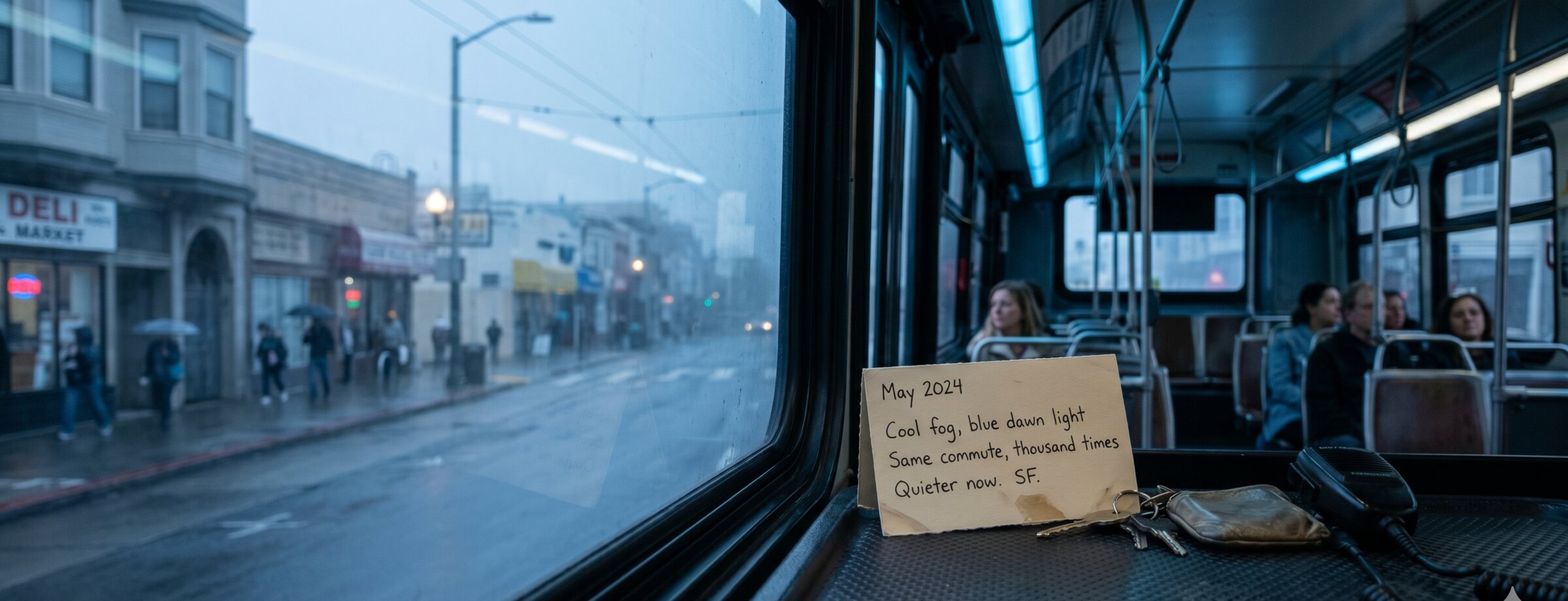
When she gets off, three stops later, at Van Ness and Sutter, she leaves a card on the seat. The card is small. About the size of a business card, on heavy cream stock. On it, in typed Courier, is a haiku. It is signed at the bottom with a single letter: M.
The drivers do not throw them out. They never have. The cards have, over fourteen years, accumulated. There are roughly 2,300 of them in a three-ring binder kept at the Presidio MUNI division. The binder is in a metal cabinet in the operators’ lounge.
The haiku are sometimes about the bus. Sometimes about the weather. Sometimes about something that happened that morning that the driver may or may not remember. Sometimes about nothing the driver can identify. They are always five-seven-five. They are always typed; never handwritten.
“We do not know her real name,” says one of the operators who has been on the 49 for nineteen years. “We have decided, collectively, not to ask. There is something at stake in not asking.”
The drivers rotate through routes; nobody owns the 49. So the haiku-leaver has, by now, encountered roughly forty different operators across the fourteen years. The binder is the shared archive.
A haiku from October 17, 2017: “the rain on Polk Street / two children with one umbrella / their mother behind.” A haiku from July 3, 2020, the year of the pandemic: “you are still driving / I am still riding / thank you / four feet between us.” A haiku from January 4, 2022, the morning after Don Severio Castro, a senior who rode the 49 every weekday at the same time, was found to have died in his apartment over the weekend: “the seat is empty / the radio still works / I will not sing yet.”
One operator, Maria Ng, who works the 49 most Mondays, started writing one back. She tapes her response, in pen, on the dashboard before her shift. The haiku-leaver has, on six occasions over three years, left a second card that morning, with a poem that appears to acknowledge Maria’s. Maria has put both cards on her bedroom mirror at home.
I asked an operator if anyone had ever followed the woman, even casually, to find out who she is. The answer was no. The implicit understanding among the operators is that the mystery is the gift. To name her would be to take it back. The binder, the operator said, would feel like evidence at a trial.