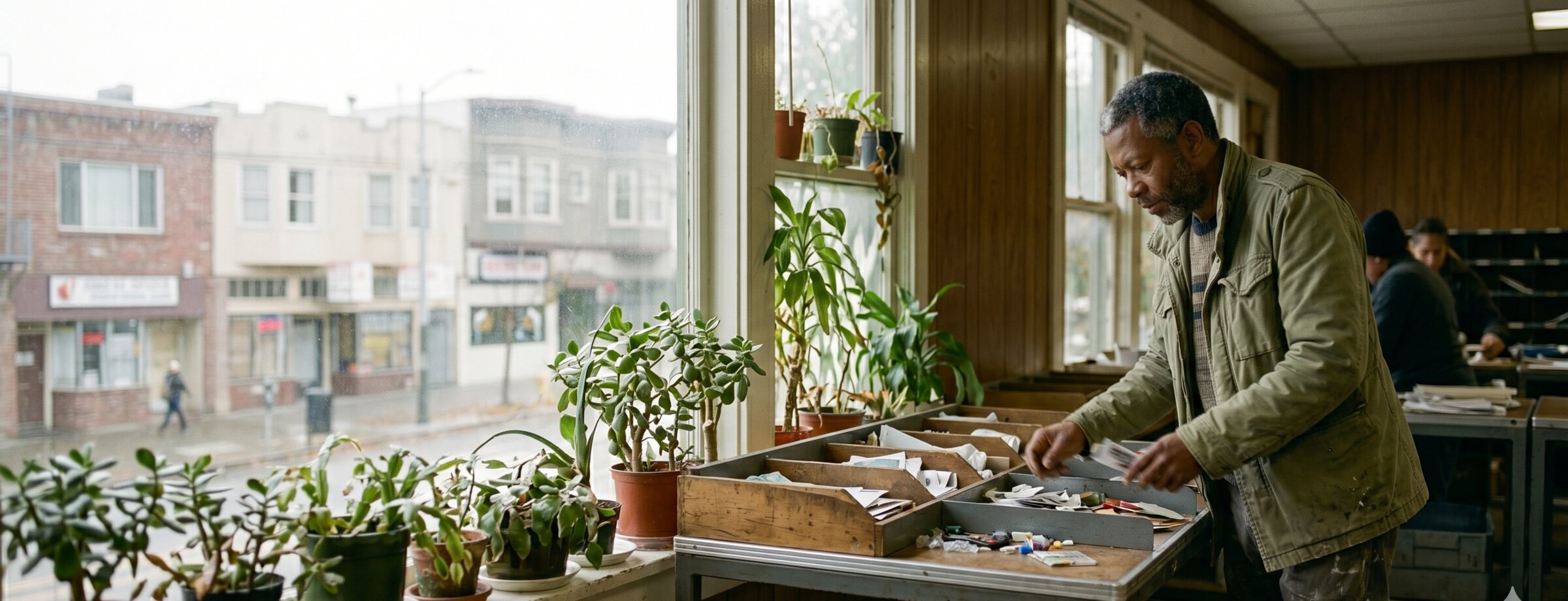
Veronica Salgado, 47, has been sorting garbage at the Recology Sunset transfer station for 19 years. She works the hand-sort line, where the fast-moving conveyor belt brings whatever a truck has just dumped on the tipping floor.
Her job is to pull out things that should not be there: a phone, a bowling ball, a frozen turkey still in the bag. The line moves at about 90 feet per minute. Her hands move faster.
“You learn to recognize a thing in half a second,” she says. “It is a brain trick I did not have when I started. After two years, I could tell you the brand of the yogurt by the lid before it passed me.”
The Sunset station processes 280 tons of residential garbage a day. By the end of one of Veronica’s eight-hour shifts, the line has carried something like 40,000 individual items. She is one of twelve sorters at any given time. The line stops twice a shift, for ten minutes each, by union contract.
I asked Veronica what she has learned about San Francisco from sorting its trash for nineteen years.
“I have learned that people throw out their wedding photos when they get divorced,” she said. “I have learned that the rich neighborhoods throw out more food than the poor neighborhoods. I have learned that everybody, no matter their income, throws out a houseplant they could not save.”
She picks an avocado pit out of the line as I watch. She drops it in the green bin. She does not break stride.
“The pit goes to compost,” she says. “We send the compost to the wineries in Sonoma. Your trash becomes someone’s zinfandel. The city is more circular than people know.”