Tariq Sims is 41. He has walked the same twelve dogs along Crissy Field every morning at 6:30 for fourteen years. He keeps a small notebook in his back pocket with each dog’s name, breed, age, owner, address, vet, and one column called “today.” The “today” column is what he writes after the walk: any change in gait, breath, eye, weight, mood.
The pack is twelve dogs from twelve different households in the Marina, the Cow Hollow, and the Presidio Heights. Tariq lives in the Outer Sunset, drives an aging Subaru Outback, and arrives at his first stop, a Pacific Heights brownstone, at exactly 6:14 a.m. He picks up the last dog at 6:28. The walk runs 6:32 to 7:48 along the bay. He drops the dogs back in the same order between 7:55 and 8:32.
He charges $32 per dog per walk. Twelve dogs, five days a week. He grosses about $96,000 a year before gas, insurance, and the leashes he buys at a feed store in Daly City. After expenses he keeps about $63,000. He has not raised his rate since 2019.
“The dogs know my car,” he says. “They are at the door before I ring the bell. I do not have to ring the bell anymore. I do anyway. The owner pays me. The owner deserves the bell.”
Tariq grew up in Oakland. He went to Skyline High School and Cal State East Bay. He studied animal science. He worked at the Oakland Zoo for two years before he was laid off in 2010 in a budget cut. He started dog walking the next month. He has not gone back to a salaried job. He has been offered three.
In 2014 he noticed that an elderly Bernese Mountain Dog named Beatrice, the third pick-up of the morning, was breathing slightly differently than the previous Friday. He called the owner from the trailhead. The owner took Beatrice to the vet that afternoon. The vet found a mass in the lung. Beatrice lived another fourteen months, which the owner attributed to the early catch.
He has called four owners over the years for similar reasons. He has been right four times. He has never been wrong.
I asked him how he knew. He said: “It is breath, not pace. The pace is what you watch with younger dogs, when they get hurt. The breath is what older dogs cannot fake. A dog’s breath in October is supposed to be a certain way. If it is not, something is wrong inside.”
Tariq does not own a dog. His apartment in the Outer Sunset is a one-bedroom that looks at the ocean and does not allow pets. He has thought about moving for a dog. He has not moved. He says he gets enough dog at work. He says, also, that having a dog at home would change his attention with the pack and that the pack is what gets paid for.
Two of the original twelve dogs from his very first morning in 2010 are still alive. They are 17 and 16, both small breeds, both still walking the Marina, slower now. The other ten have died over the years. Tariq has gone to seven of the ten’s end-of-life vet appointments at the request of the owners. He sits in the room. He puts his hand on the dog’s shoulder. He does not say anything.
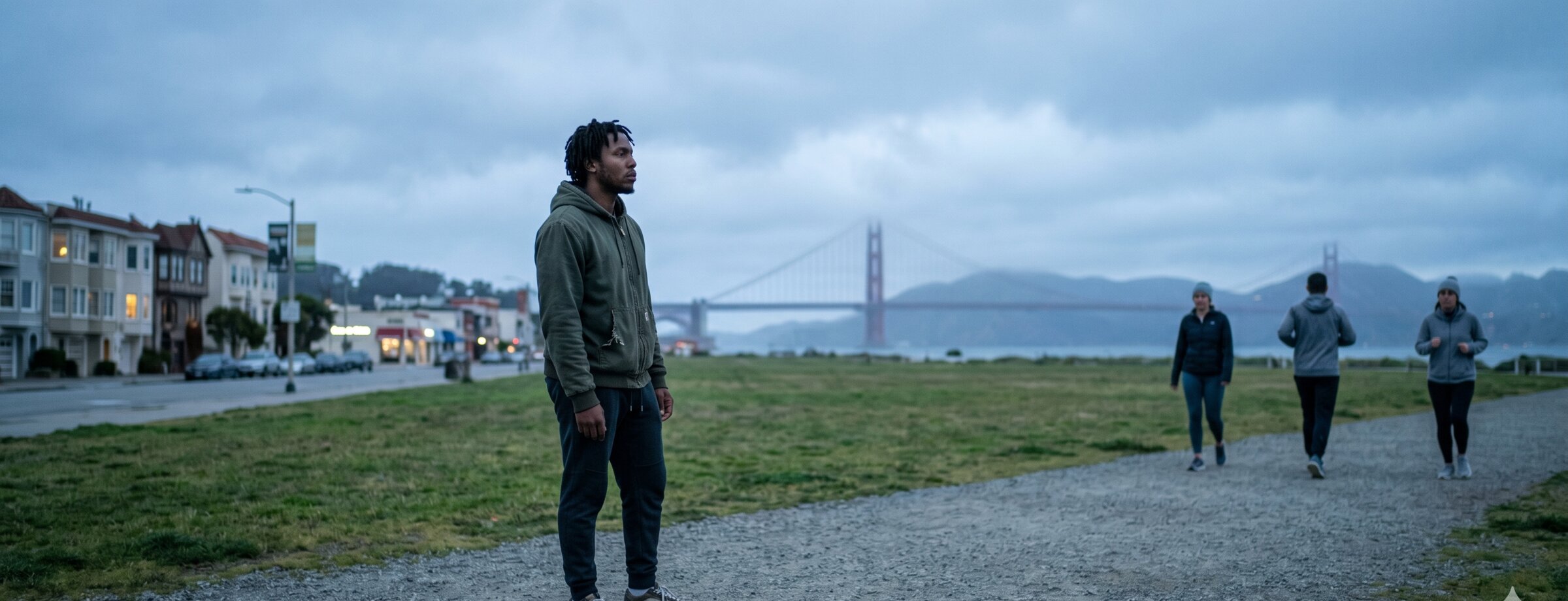
On a Friday in late September I went on the walk. The pack moved as one body, as if connected by an invisible rope ten feet wide. At Crissy a young Lab named Felix lagged briefly. Tariq paused. He watched Felix for thirty seconds. Felix was fine; he had stopped to investigate a piece of driftwood. Tariq wrote, in the “today” column: Felix, driftwood, 90 sec, no change. They kept walking. The Golden Gate was in the fog. The pack didn’t notice.