In a kitchen on the second floor of a four-unit walk-up on Russia Avenue, Doña Luz Estrada has been making tamales for the cafeteria staff of three Excelsior public schools every weekday since September 2003. She does not deliver to the kids. She delivers to the women who serve the kids.
There are eight women, total, across the three schools. They start at 6:30 a.m. They serve breakfast at 7:15 and lunch at 11:45. They eat between waves, usually whatever the cafeteria has on hand: a piece of fruit, a styrofoam bowl of soup, half of a hot dog. Doña Luz noticed in 2002 that the women rarely had anything from home. She asked one of them why. The woman said, “I don’t have time.”
The next September, Doña Luz started making tamales. She made them in batches of 24, three per woman, eight woman, plus a few spare. She delivered them to the back doors of the three school kitchens at 6:18 a.m. on her way to her own job at a laundry on Mission Street. She has not missed a weekday since.
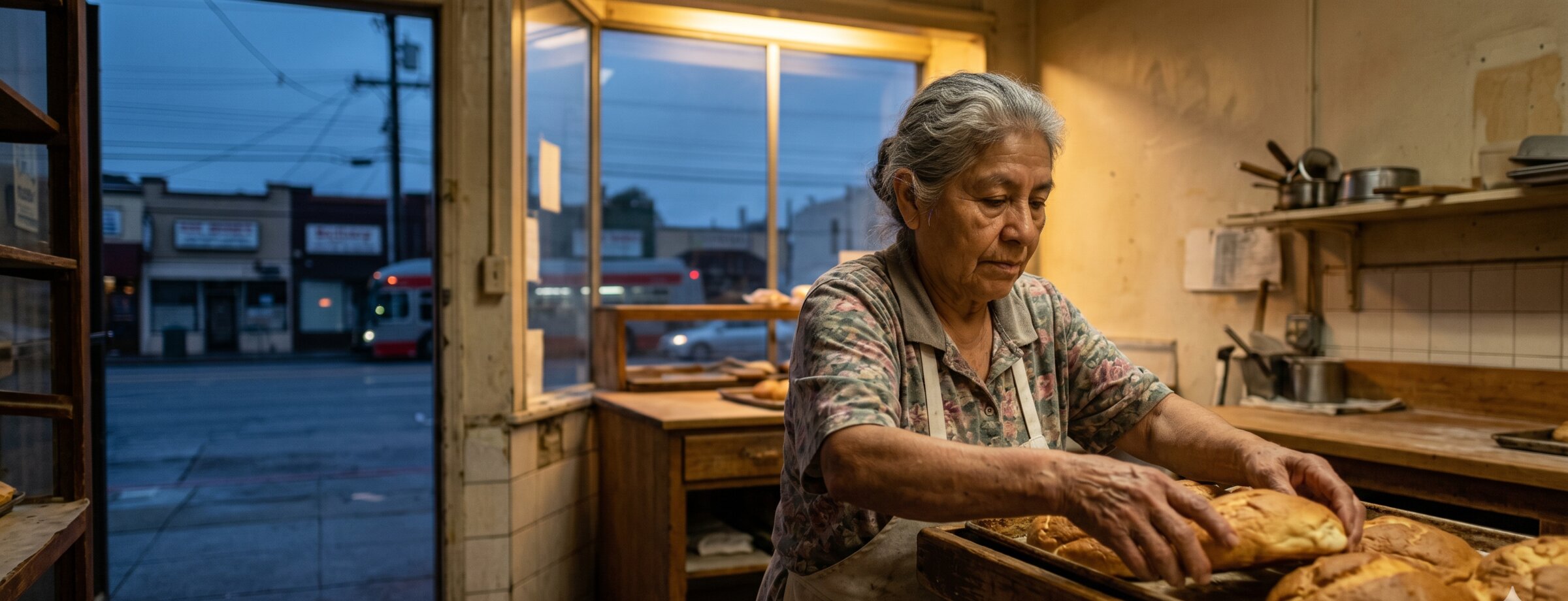
She is 67. She came to San Francisco from Michoacán in 1983. She raised three children on Russia Avenue, all grown now, none living in California. She retired from the laundry in 2018 but kept the tamale schedule.
“The lady who feeds the kid in line is a person too,” she says. “Somebody has to feed her. The somebody is me.”
The tamales rotate. Mondays are pollo verde. Tuesdays are red chile pork. Wednesdays are rajas y queso. Thursdays are sweet pineapple-coconut. Fridays are mole. Doña Luz makes the masa Sunday afternoons. She steams in two large pots on a four-burner gas stove that she has had since 1991.
She has not raised her cost. She does not charge anything. The food is paid for out of her social security, plus an envelope of cash that one of the cafeteria women, Marisol, organizes among the eight every quarter. The envelope is usually $80 to $200. Doña Luz puts it in a coffee can in the cabinet under the sink. She uses it to buy masa and chile from the market on Geneva.
Marisol, who is 54, has worked the cafeteria at one of the three schools for 19 years. She is the one who notified Doña Luz when one of the eight, a woman named Patricia, was diagnosed with breast cancer in 2017. Doña Luz made Patricia a special tamale that week, the kind her own mother had made for her aunt with cancer in Mexico, with a particular herb the family believed brought strength. She delivered them with a small note. Patricia recovered. She still works the kitchen. She still calls them “Doña Luz’s strength tamales.”
In a school district that has cut food-service hours twice in the last decade, the eight women are paid less than a living wage and work full-time. Doña Luz does not know this in dollar amounts. She knows it from the number of times the women have come to her door asking, in tears, for a small loan.
The loans are repaid or forgiven. Doña Luz keeps no ledger. She does not feel that the borrowers owe her. She feels that the borrowers feed her city’s children and that she is the one who owes them.
On the Tuesday I visited at 5:14 a.m., she had finished steaming the morning batch. Twenty-four tamales sat on a clean dish towel on her kitchen table. She wrapped them in foil, then in newspaper, then put them in a wicker basket she has used for all twenty-two years. She walked the seven blocks to the first school by 6:08, the second by 6:14, and the third by 6:21. Each delivery took less than two minutes. She did not stay to be thanked. She walked back to Russia Avenue with the empty basket and made a cup of instant coffee and read the news on her phone.