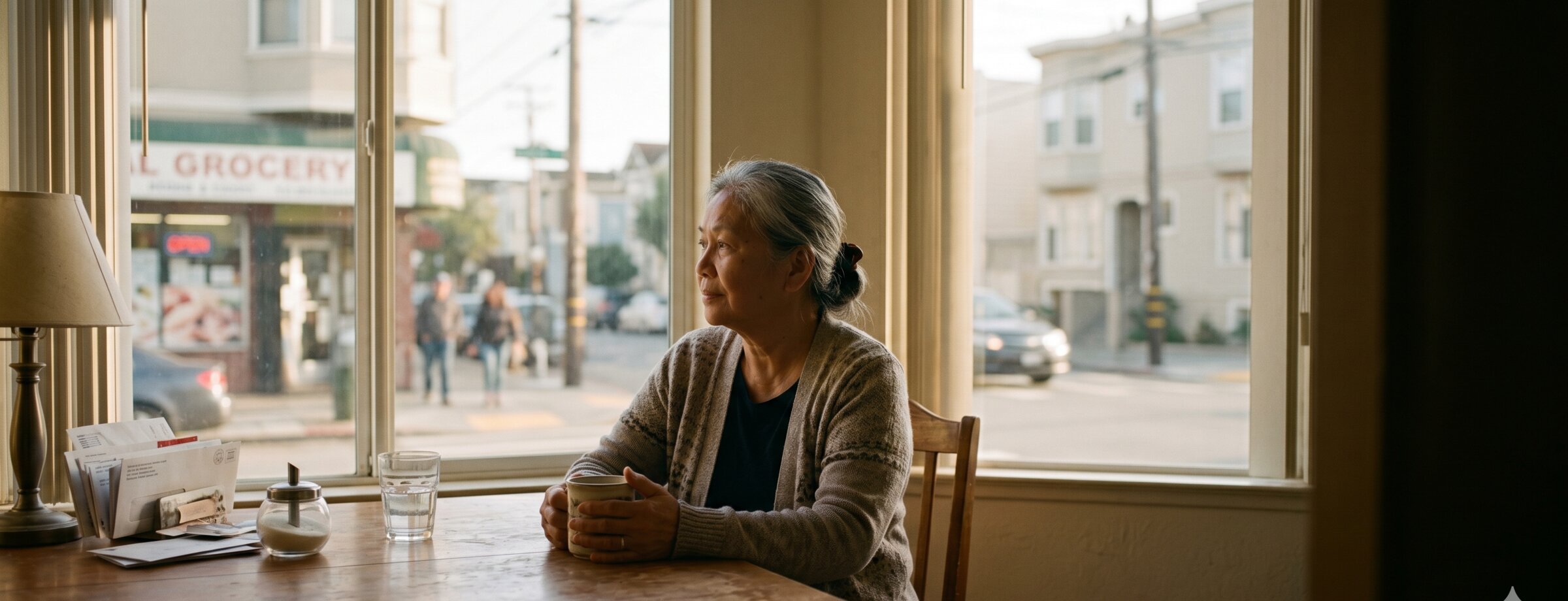
On a Wednesday afternoon at 2:41, Lourdes Aquino is sitting at her kitchen table on Geneva Avenue with a mug of barako coffee, a yellow legal pad, and a woman named Mrs. Garcia who has come from three blocks over to ask her to write a letter.
Mrs. Garcia is 78. She speaks Tagalog and Ilocano. She reads English well enough to recognize her name on a piece of mail and the words “owe” and “evict.” She does not feel comfortable writing in English. The letter she needs is to her grandson, who lives in Las Vegas, who has not called her in six months.
Lourdes is 71. She came to San Francisco from Cebu in 1979 with a nursing degree she would never use professionally because she could not pass the California exam in time and her three children needed her to take a job at the bakery on Mission Street that paid by the hour. She raised her children, lost her husband to a stroke in 2003, and started writing letters for her neighbors in 1998.
“It started because Mrs. Reyes, two doors down, got a letter from PG and E saying her gas would be turned off,” Lourdes says. “Her son was at work. Her grandson was at school. I read it for her. I called the company for her. I wrote the response. After that, somebody else came. Then somebody else.”
She keeps a notebook of every letter she has written, organized by year. The columns are date, person, subject, outcome. She estimates she has written about 4,200 letters in 27 years. She has never charged. People bring her food. She has a freezer full of tamales and pansit.
The subjects are what you would expect. About half are administrative: Social Security, MediCal, landlord disputes, immigration paperwork, jury duty exemptions, school enrollments for grandchildren. About a third are family: a letter to a son in another state, a letter to a daughter who has stopped speaking to a parent, a letter of apology, a letter of forgiveness.
A small number, perhaps two dozen a year, are letters Lourdes describes as “the last letter.” A person, usually elderly, knows they are dying. They want to write a letter to be opened after their death. They dictate. Lourdes writes. They sign. Lourdes keeps a copy in a manila envelope marked with the date.
“I do not show those to the family afterward unless they come asking,” she says. “Some people want their letter to be a surprise. I respect that.”
In 2019, a woman named Mrs. Tanaka, 89, who lived in the same building as Lourdes’s sister, came to dictate a letter to her son in Tokyo. The son had been estranged for eleven years over an old fight about money. Mrs. Tanaka had stage four pancreatic cancer. The letter was four pages. Lourdes wrote the English translation in pencil, then re-wrote the Japanese in Mrs. Tanaka’s handwriting because Mrs. Tanaka’s hands had begun to tremble.
Mrs. Tanaka died six weeks later. Her son flew to San Francisco for the funeral. He came to Lourdes’s apartment afterward, with a small bag of green tea and a card. He told her, in halting English, that the letter had reached him on a Tuesday. He had read it on a bench in Yoyogi Park. He had bought the plane ticket the next morning.
“That is a story I tell when the work feels too much,” Lourdes says. “When my back hurts and the ceiling has a stain and another neighbor calls. I think about that man on the bench in the park.”
Mrs. Garcia’s letter to her grandson takes 22 minutes to draft. Lourdes reads it back in Tagalog. Mrs. Garcia nods at every line. The final paragraph is Lourdes’s suggestion, not Mrs. Garcia’s: a sentence saying, “I will be home for Christmas if you call before December 1.” Mrs. Garcia hesitates, then nods.
Lourdes prints the letter on a small inkjet printer her son gave her in 2016. She addresses the envelope. Mrs. Garcia signs her name. Lourdes will walk it to the mailbox on Mission Street on her evening walk. She has not missed a Wednesday letter in 27 years.