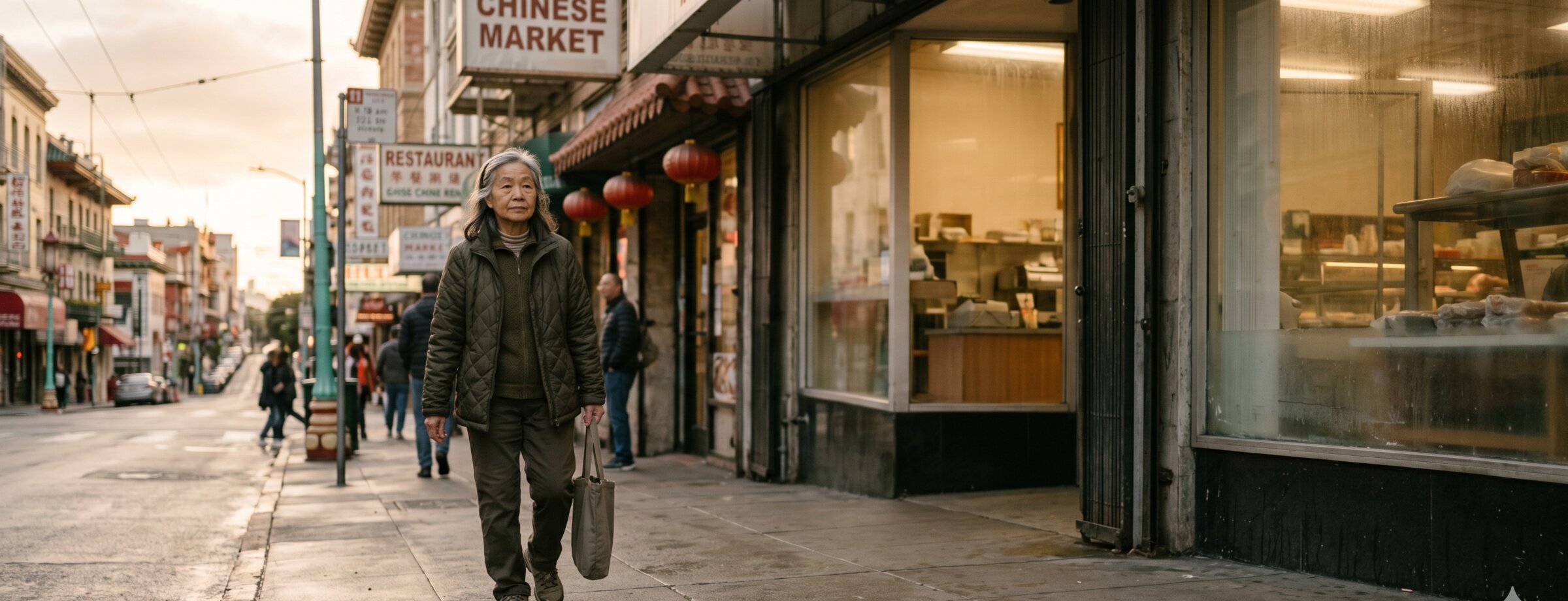
Mrs. Lin Chen is 89. She is four foot ten. She has lived in the same one-bedroom apartment on Stockton Street since 1971. She has been at every single major San Francisco protest since the I-Hotel evictions in 1977, and most of the small ones, and most of the city council meetings where small ones started.
The wooden sign is forty-three years old. Her late husband, Henry, made it for her in 1982 out of a piece of redwood salvaged from a dock at the Hyde Street Pier. The sign is two feet by three feet. It has a slot in the middle. Mrs. Chen slips a fresh cardboard insert into the slot before each protest, hand-lettered the night before, in Cantonese on one side and English on the other.
She came to San Francisco from Guangzhou in 1968 with Henry and their two-year-old daughter. Henry worked at a printing shop on Pacific. Mrs. Chen worked at a sewing factory on Vallejo for 19 years before her hands started to shake.
Her first protest was the I-Hotel, August 1977. The city was evicting the elderly Filipino and Chinese residents of the International Hotel on Kearny so the building could be torn down. Mrs. Chen stood in the human chain that wrapped the hotel for seven hours the night of the eviction. She was 41. She was knocked down once by a sheriff’s deputy. She got back up. She has not stopped getting back up.
“My daughter was nine,” she says, in Cantonese, then English. “I told her, your mother is going to a thing tonight. She might come home or she might come home in the morning. The thing is more important than what time I come home.”
Mrs. Chen has been at every March for Chinese American civil rights since 1985. She was at the Castro on the night of Harvey Milk’s death in November 1978; she did not know him personally, she went because her hairdresser, who was gay and lived three blocks from her, asked her to come. She was at the City Hall vigil after the 1989 earthquake. She was at the immigration rights march of 2006, the day after Easter, walking with a Filipina aide who had moved into her building. She was at the women’s march in January 2017. She was at every Black Lives Matter march in San Francisco in 2020, masked, carrying the same sign.
She has been arrested twice. Once in 1995 at a SROs protest on Sixth Street; she chained herself to a railing and was cited and released. Once in 2003 at an Iraq War protest on Market Street; she was held for six hours in a tent at Pier 27 with about three hundred others. Both arrests are entered, by date and citation number, in a brown notebook she keeps in a drawer in her kitchen.
I asked her if she has ever lost a friend over a protest. She said no, not once. She said the people who would lose her over a protest were not her friends in the first place; they were people who agreed with her, which is a different thing.
Henry died in 2004 of pancreatic cancer. Mrs. Chen kept going to protests. Her daughter, who lives in San Mateo and is now 60, asks her to slow down. Mrs. Chen says her age is not a reason to slow down. Her age is the reason to speed up.
In April 2026 she went to a city council hearing on a proposed rent ordinance. She brought the sign. The Cantonese side read 唔好趕走老人. The English side read DO NOT EVICT THE ELDERS. The hearing went six hours. She stayed for all six. She did not testify; she has, she says, said her piece. She came to be in the room because being in the room is the work.
On the way home she stopped at a bakery on Stockton Street for a coconut bun. She ate it on the sidewalk. The owner, who has known her since 1989, gave it to her free. He has been giving her free bread on Mondays for thirteen years.
I asked her what would make her stop. She said: “When I cannot walk to the room, I will roll to the room. When I cannot roll to the room, I will write to the room. When I cannot write to the room, I will be the reason somebody else came to the room.”