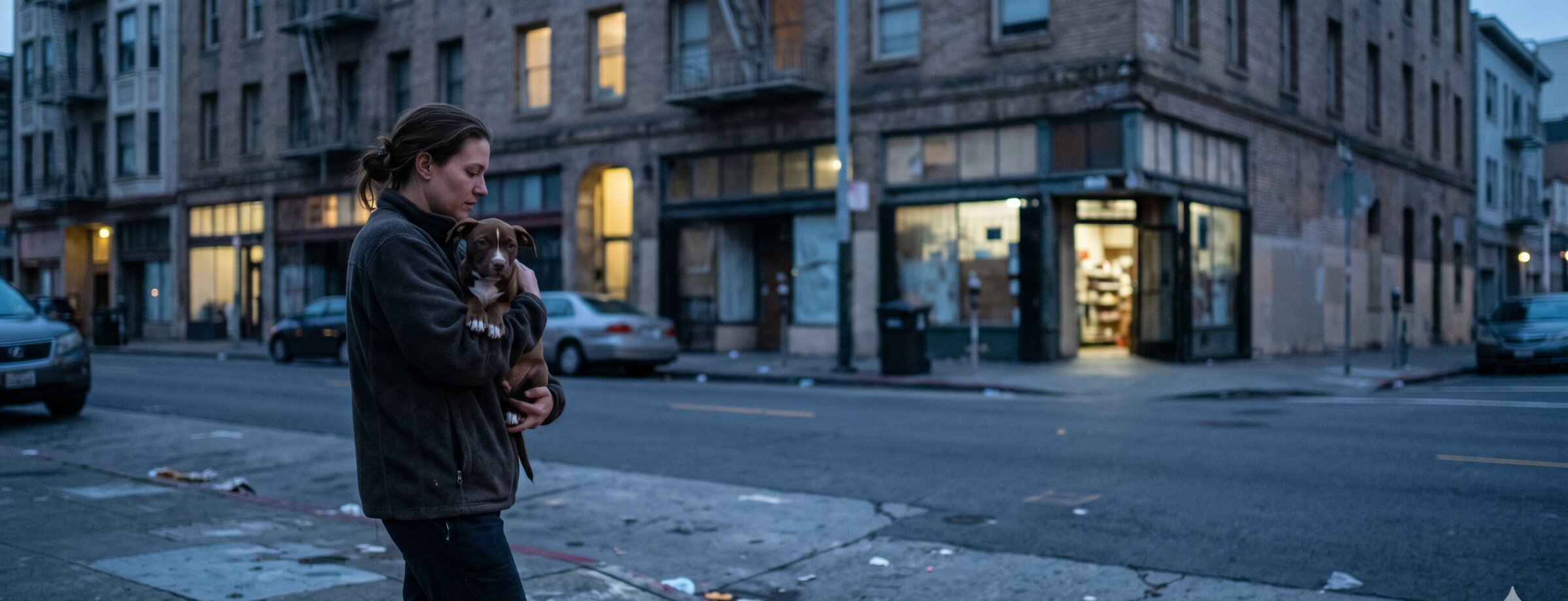
Four nights a week, between 11 p.m. and roughly 4 a.m., Maxine Otter walks the Tenderloin. She walks a perimeter that takes her about three hours, with stops. She carries a soft leash, a small canvas bag of dog treats, a flashlight, a hand-warmer in winter, and an old Nokia phone that has the numbers of seven foster families in her speed dial. She is looking for dogs that have been abandoned. She has been doing this for nine years. She has, by her own ledger, rescued and rehomed 412 of them.
Maxine is 47. She grew up in the Sunset. She was a heroin user from age 22 to 38. She had two overdoses in 2014. She got clean in February 2016 in a rehab program at Walden House. She has been clean for nine years. She started rescuing dogs the same year she got clean. The two things, she says, are not unrelated.
“The dog did not choose the night,” she says. “I did not choose mine. We figure out the morning together.”
Dogs in the Tenderloin get abandoned for many reasons. Their owners go to the hospital. Their owners get arrested. Their owners overdose. Their owners are moved out of an SRO without their pets. Their owners can no longer feed them. Their owners die. About a third of the dogs Maxine finds, by her count, belonged to people she has met before, in some capacity, over the years.
Maxine keeps a ledger of every dog she has rescued. The ledger lives in a binder on her kitchen table. Each entry has: the date of the rescue, the corner where she found the dog, a Polaroid of the dog the night she found him or her, the dog’s rough breed and age, the foster family the dog went to, and the date the dog was adopted. Some entries have a small star next to them indicating a dog that died in foster care before adoption. There are 38 stars.
She works with seven foster families across the Bay Area. They are all volunteers. Two are former addicts; the rest are not. All of them have been vetted by Maxine personally. She has been with most of them for more than five years. She drives the rescued dog from the Tenderloin to the foster home herself, at 4 or 5 a.m., in a 2007 Honda CR-V that has 234,000 miles on it.
She is not officially an SPCA volunteer or an animal control affiliate. She has tried to formalize the work with the city three times. Each time the bureaucracy made it impossible to keep working at the hours she actually works. She gave up on the formality but has, over the years, built informal relationships with three SFPD officers who patrol the Tenderloin overnight and who, when they encounter an abandoned dog on shift, call her.
The night work is funded by donations through a small Venmo and a recurring monthly Patreon-style page with about 90 subscribers. Maxine grosses about $26,000 a year from these. After vet expenses and gas, she clears about $7,000. She works a part-time day job at a coffee shop to make ends meet. She does not pay herself a salary out of the donations.
On the Friday I rode with her at 1:14 a.m., she found a pit-mix puppy, about ten weeks old, in a stairwell on Eddy Street. The puppy was malnourished but not aggressive. Maxine read her tag. There was no tag. She put on the leash. She wrapped the puppy in her own jacket. She did not raise her voice. She walked the puppy back to her CR-V and called a foster family in El Cerrito who would meet her at 3:30 a.m. The puppy was, by morning, asleep on a rug in El Cerrito. Maxine drove home with the heater on.
I asked Maxine if she has ever found a dog she could not place. She said yes, twice. Both times she kept the dog herself. The first one, a small white terrier named Tilda, died of old age in 2021. The second one, a brindle American Bully named Buddy, is sleeping on her bed right now.