Ramona Acosta is the third welder in her family. Her grandfather, Eduardo Acosta, welded the hulls of seven Liberty ships at the Hunters Point Naval Shipyard between 1942 and 1969. Her father, Tomás, welded scaffolding for the Embarcadero in the 1980s. Ramona, 38, is on the bridge crew that maintains the eastern span of the Bay Bridge. She has worked on the bridge for nine years. She was the first woman in her family’s line to do the job. There are now four others on her crew.
She keeps her grandfather’s torch on a shelf in her apartment in the Excelsior. It is a Victor Tournament 9 from 1953. He bought it new with $43 of his second paycheck. The brass is darker now where his thumb sat. Ramona will sometimes pick it up to check the weight before a long shift. She has never used it. The fittings would not match modern lines.
The Hunters Point Naval Shipyard closed for good in 1974. Eduardo retired in 1969 with a back that never quite worked again. The buildings he welded inside were demolished between 2008 and 2018. Ramona drives past the parcel sometimes on her way home from a Bay Bridge shift. The condos there sell for $1.2 million for a one bedroom.
“My grandfather built ships that carried things to people who needed them,” Ramona says. “The ships are at the bottom of the ocean now. The buildings he welded are gone. I told him at his ninetieth birthday that he had built nothing that was still standing. He looked at me. He said, you are still standing.”
Ramona’s job on the Bay Bridge crew is mostly preventive: she finds and repairs cracks in the steel before they become structural problems. The eastern span she works on opened in 2013. She has welded on every quarter mile of it. She has welded in the dark, in sideways rain, twice in fog so thick she could not see the cone of her own welding helmet.
The crew works in three shifts. Ramona prefers the 4 a.m. start because the bridge is mostly empty and the ironwork is at its coldest, which makes the bead easier to control. She listens to her grandfather’s old AM radio, which she keeps in her tool kit, set to 1010 KIQI.
Her father, Tomás, died of lung cancer in 2014. He had not welded in twelve years by then. The cancer was probably from the welding fumes; that was the family’s working theory and the doctor’s. Ramona has been wearing her N95 since the day after her father’s funeral. She nags every younger welder on her crew to do the same. About a third do.
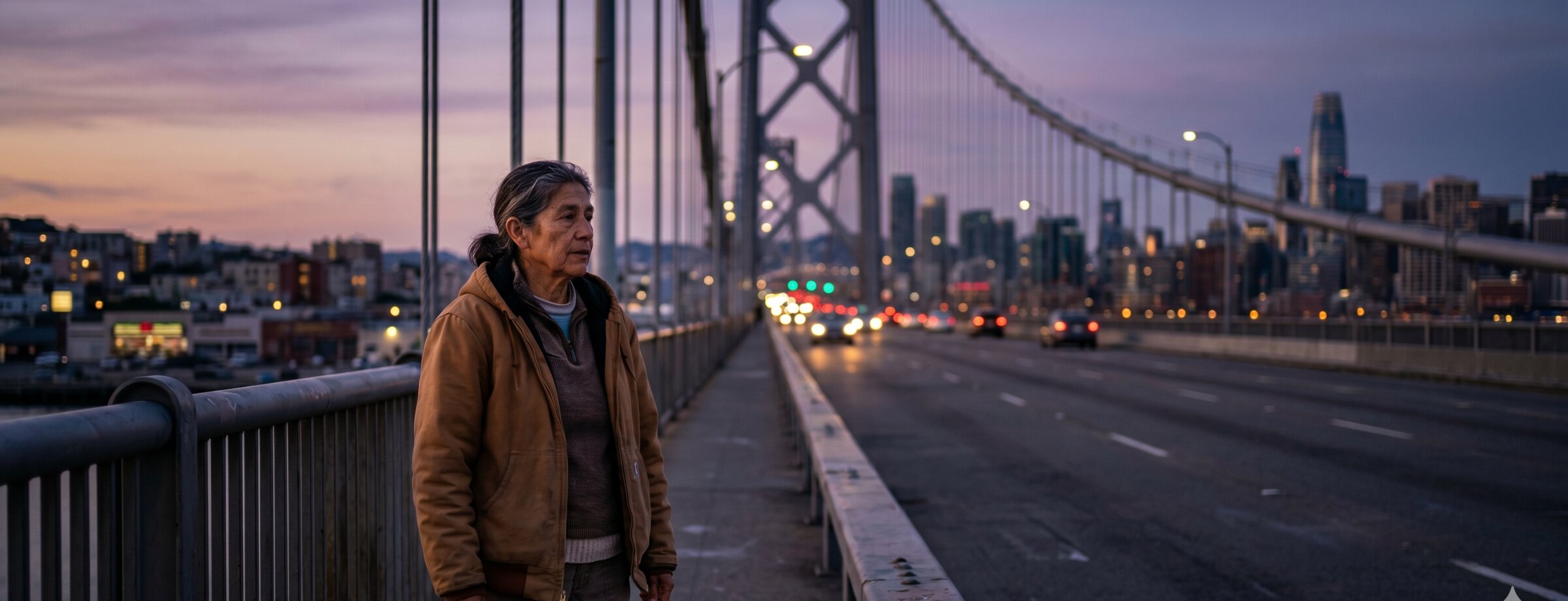
In 2019 Ramona helped weld the seismic retrofit on a section of the bridge above Yerba Buena Island. The repair was small, eight bead-feet of weld in three places. The supervisor signed off. Three weeks later Ramona drove a friend across the bridge at sunset and pointed out the spot. The friend said, “I would not have known.” Ramona said, “That is the job.”
On a Tuesday in late September I rode out to the bridge with her crew at 3:42 a.m. We climbed up to the steel below the deck through a hatch the size of a footstool. Ramona welded for forty minutes in a position you cannot describe without hands. Halfway through, a vibration in the steel told her a truck had crossed sixty feet above us. She paused without looking up. She finished the bead. She knocked on the steel twice with the back of her glove. She has done that, she says, since the first day. It means: we are good.
After the shift she went home, slept four hours, and walked her son to school. Her son is 11. He has asked her once if he could be a welder when he grew up. Ramona told him he could be anything. Then she told him, more quietly, that there were better ways to keep things up than welding them. He looked at her for a long second. He said, OK. He has not asked again.
On the shelf, the torch is in a leather case her grandfather sewed himself in 1958. The case has a small inscription on the inside flap, in Spanish, in his hand. It reads: “Para mi hijo, si lo necesita, y mis nietos, si recuerdan.” For my son, if he needs it, and my grandchildren, if they remember. Ramona remembers.